- Popular countries
- Popular regions
- Popular cities
- Popular airports
- Car Rental Italy
- Car Rental Spain
- Car Rental United States
- Car Rental Portugal
- Car Rental South Africa
- Car Rental France
- Car Rental Netherlands
- Car Rental Greece
- Car Rental Germany
- Car Rental United Kingdom
- Car Rental Belgium
- Car Rental Croatia
- Car Rental Switzerland
- Car Rental Austria
- Car Rental Denmark
- Car Rental Norway
- Car Rental Australia
- Car Rental Ireland
- Car Rental Cyprus
- Car Rental Canada
- Car Rental Florida
- Car Rental Sicily
- Car Rental California
- Car Rental England
- Car Rental Sardinia
- Car Rental Mallorca
- Car Rental Ibiza
- Car Rental Crete
- Car Rental Tenerife
- Car Rental Rhodes
- Car Rental Madeira
- Car Rental Corsica
- Car Rental Gran Canaria
- Car Rental Malta
- Car Rental Scotland
- Car Rental Azores
- Car Rental Fuerteventura
- Car Rental Lanzarote
- Car Rental Corfu
- Car Rental Zakynthos
- Car Rental Amsterdam
- Car Rental Milan
- Car Rental Miami
- Car Rental Lisbon
- Car Rental Malaga
- Car Rental Porto
- Car Rental Rome
- Car Rental Cape Town
- Car Rental Barcelona
- Car Rental Faro
- Car Rental Alicante
- Car Rental Nice
- Car Rental Bari
- Car Rental Naples
- Car Rental Johannesburg
- Car Rental Brussels
- Car Rental Bergamo
- Car Rental Orlando
- Car Rental Palma de Mallorca
- Car Rental Vienna
- Car Rental Amsterdam Schiphol Airport
- Car Rental Miami International Airport
- Car Rental Lisbon Airport
- Car Rental Malaga Airport
- Car Rental Porto Airport
- Car Rental Milan Malpensa Airport
- Car Rental Rome Fiumicino Airport
- Car Rental Faro Airport
- Car Rental Alicante Airport
- Car Rental Bari Palese Airport
- Car Rental Nice Airport
- Car Rental Barcelona Airport
- Car Rental Cape Town Airport - International Terminal
- Car Rental Bergamo Airport
- Car Rental Orlando International Airport
- Car Rental Mallorca Airport
- Car Rental Catania Airport
- Car Rental Johannesburg International Airport
- Car Rental Ibiza Airport
- Car Rental Athens Airport

12 stops between Venice and Florence
Exploring cultural attractions and natural beauty in a rental car
Venice and Florence are two of the most popular Italian cities to visit—the former for its picturesque canals and the latter for its Renaissance art and architecture. These two cities are less than 270 kilometers apart, and if all goes well, you can cover that distance in just over three hours. But we’re assuming you’ll want to rent a car to see more of Italy than just the autostrada. There’s so much beauty between Venice and Florence, especially if you take detours, as we do on the road trip below.
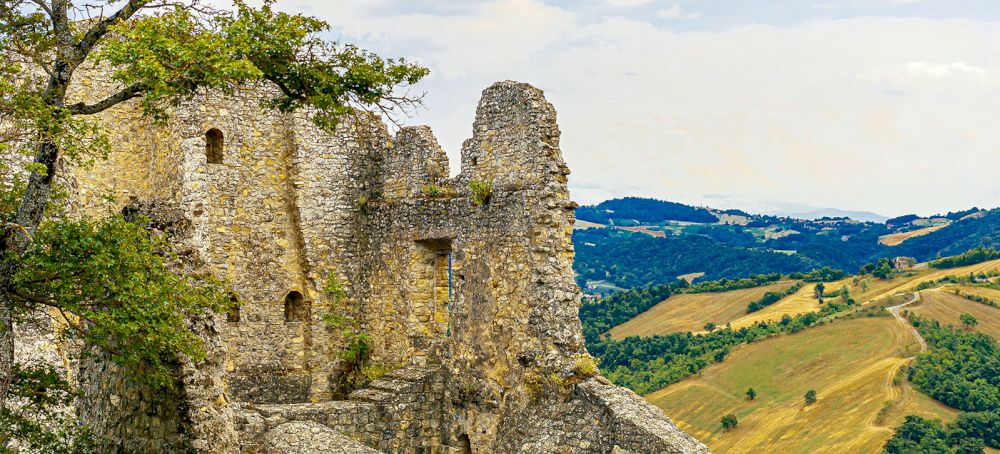
Each of the cities and towns on this trip is special. The great treasures of Venice and Florence are, of course, amazing, but it’s especially the lesser-known highlights that make this road trip so impressive. And let’s not forget the scenery: from the foothills of the Alps through the vast Po Valley and the mountains of the Apennines to the lovely hills of Tuscany.
1. Venice
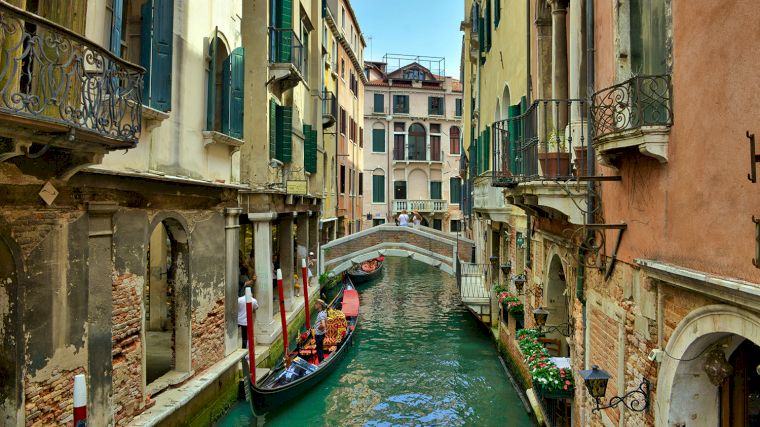
Venice needs no introduction: this romantic city, spread across more than a hundred small islands, is a place unlike any other in the world. You can’t drive a car around Venice, so if your road trip starts or ends here, it’s better to pick up your rental car later or return it earlier. If the city is a stopover on your trip through Northern Italy, it’s best to park in Mestre on the mainland. A short train ride will then take you to Venice. You can also park your car just past the bridge to Venice, but those parking lots and garages are extremely expensive and often full. Venice is a huge tourist magnet, which is why, starting in 2024, you’ll have to pay an entry fee if you don’t have a hotel reservation in the city itself.
Despite the large numbers of tourists, Venice is well worth a visit. In early spring (March–April) or late fall (October–November), the city may be shrouded in fog, but there are definitely fewer tourists than in the summer. And that fog can also create a mystical atmosphere, especially if you seek out the less crowded spots, such as the colorful islands of Burano and Murano or the former working-class neighborhood of Giudecca.
2. Prosecco Wine Route
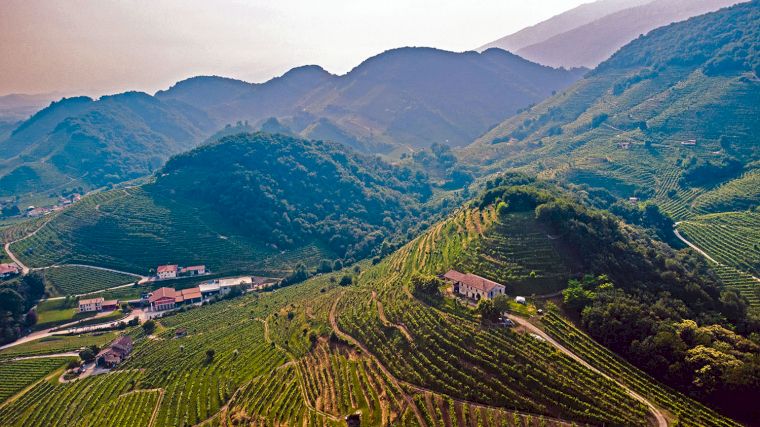
To drive to Padua, you can take the A4 highway, but in our opinion, that’s never a good idea if you’re not in a hurry and want to get the most out of your vacation. Why not take a detour from Venice through the hills (colline) of the Prosecco region? Stop along the way in the walled city of Treviso, with its many canals and narrow alleys. Because of its proximity to Venice, it’s often overlooked, which means you’ll find fewer tourists and more locals there. Incidentally, Treviso Airport is also close to the area where the world-famous wine comes from. Drive your rental car from Conegliano to Valdobbiadene over beautiful ridges and through old farming villages. The vineyards are situated on narrow terraces along steep slopes. It’s an enchanting landscape, shaped and adapted by humans but with respect for nature.
Just before the end of the route, you can enjoy lunch with a fantastic view while sipping a glass of Prosecco at Osteria Senz’Oste, the tavern without a host. You’ll discover the story behind it once you’re there.
3. Padua
Padua ( Padova in Italian) is a lively city, thanks to its renowned university, one of the oldest in the world. Chances are you’ll come across a graduation celebration. When a student graduates, friends sing to the new “dottore” in the street with a song that’s not very subtle but well-intentioned. If you’re visiting this charming city, there are plenty of places to park your rental car north of the old town.
At 90,000 square meters, Prato della Valle is Italy’s largest square and one of the largest in Europe. It was originally a Roman theater and later a fairground. In 1775, it took on its current layout: a large central lawn surrounded by an elliptical canal lined with a double row of statues. On Saturdays, there’s a large market on the square, and concerts are also held there regularly. Incidentally, there’s also a parking lot south of this square.
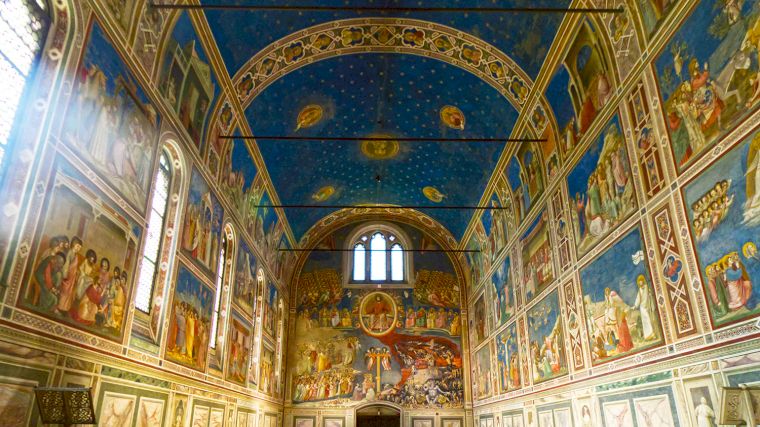
Even if you’re not religious, you’ll be impressed by Giotto’s astonishingly colorful and vivid frescoes that cover the entire Cappella degli Scrovegni. Are those frescoes boring for kids? Not if you have them play a scavenger hunt. For example: find the picture where Jonah is swallowed by a whale. The chapel is very popular, so you’ll need to buy an admission ticket online in advance.
4. Colli Euganei
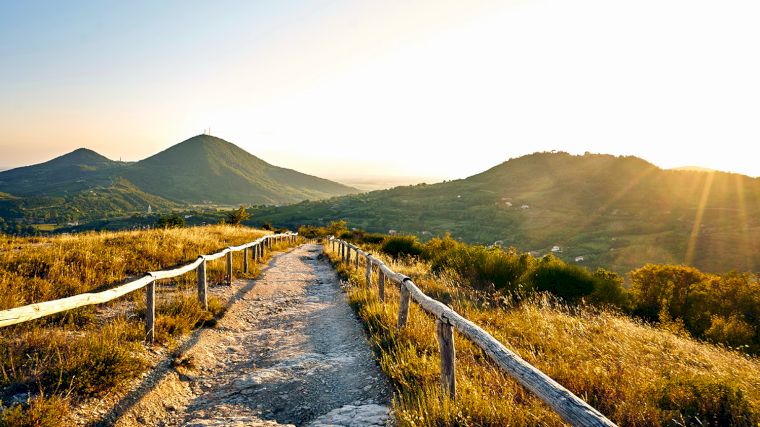
For our next destination, Vicenza, we’ve also planned a lovely detour through the Colli Euganei, southwest of Padua. The roads here wind through the volcanic hills that characterize the regional park of the same name. Along the way, you’ll enjoy views of vineyards, centuries-old olive groves, and picturesque villages. Make a stop at Villa dei Viscovi, a beautifully restored old Italian villa perched high on a hill and surrounded by a stunning garden. There’s also a restaurant, though it’s sometimes fully booked. Zip lines, suspension bridges, and other climbing and scrambling activities through the woods can be found at Parco Avventura Le Fiorine.
5. Vicenza
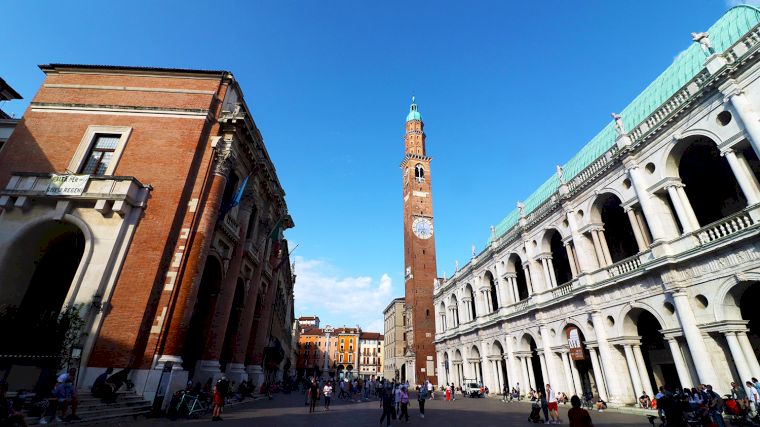
If you love 16th-century architecture, you shouldn’t miss Vicenza. The architect Andrea Palladio, in particular, left a lasting mark on the city. He built many palazzi there, as well as the Teatro Olimpico, the oldest covered theater in Europe. The painted panels inside, depicting lifelike street scenes, are the work of Vincenzo Scamozzi, a student of Palladio. The Basilica on the beautiful Piazza dei Signori was a renovation project in which Palladio concealed the original Gothic building behind a Neoclassical façade. Next to it stands the Torre Bissara, a tall bell tower that was built as early as the 12th century and later raised.
6. Valli del Pasubio
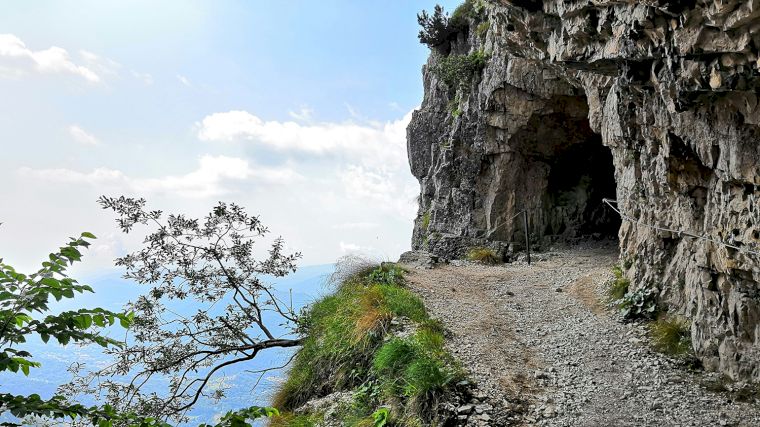
Can’t get enough of detours? Neither can we. Drive northwest from Vicenza via the Strada del Pasubio (SP46/SS46). Especially from the village of Valli del Pasubio, it becomes a phenomenal road through the mountains. During World War I, this area was of enormous strategic importance. At that time, the Pian delle Fugazze mountain pass marked the border with Austria, and the Italian army decided to build a trail out of range of the Austro-Hungarian artillery. That hiking trail, the Strada delle 52 Gallerie, winds between the deep canyons and steep rock faces of the Pasubio massif and passes through no fewer than 52 tunnels. An easier option is the flat hike along La Via dell’Acqua, which follows a small river just outside Valli del Pasubio.
7. Verona
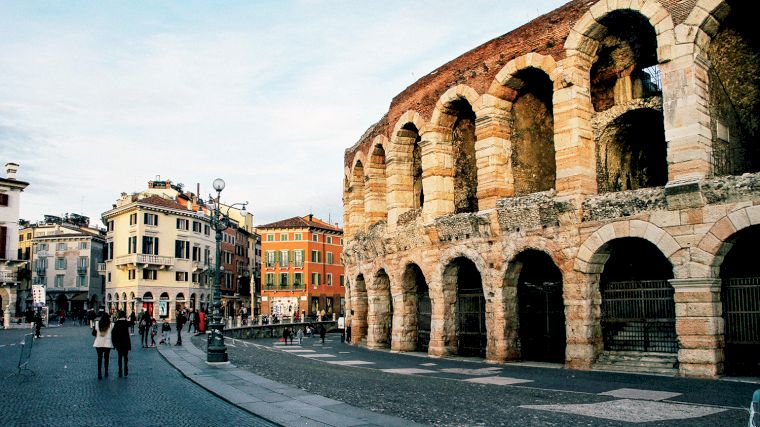
Shakespeare set his romantic tragedy *Romeo and Juliet* in Verona, which is why it’s often called Italy’s most romantic city. To be honest, that’s a bit of an exaggeration, and the hype surrounding the famous balcony certainly is. After all, it’s highly doubtful that the two lovers actually existed, let alone that Juliet ever stood on that balcony.
The fact is, though, that Verona is a beautiful city. As in most Italian cities, there’s no shortage of squares, with Piazza Bra being the largest. Among the colorful buildings, you’ll find many restaurants, but be sure to reserve a table if you want to eat there in the evening! Right next to this square lies the gigantic Arena di Verona, one of the largest surviving amphitheaters, which is still used for opera performances. Attending a performance at this historic site is a truly memorable experience.
Another charming square is Piazza delle Erbe, which served as the Forum in Roman times. It’s still a bustling meeting place full of life. As in many old cities, the best thing to do is simply wander around and see where you end up. Verona is full of beautiful spots, but there’s one we’d like to highlight because it offers a fantastic view of the old city: Castel San Pietro. You can get there by crossing the Ponte Pietra and walking up the hill through a narrow alley. Don’t feel like walking? There’s also a cable car that takes you to the top.
Verona is located near Lake Garda, so you can take a short detour along the shores. If you’re traveling with kids who need to burn off some energy, a day trip to the Gardaland amusement park is a great idea.
7. Parma
Some people find the landscape of the Po Valley monotonous, but you can actually find interesting towns and villages there. For example, if you drive from Verona to Parma via back roads and make a stop in Mantua. It was one of the most important cultural centers during the Renaissance, and there are still many buildings there that made Mantua famous. Then drive to Parma via the charming town of Sabbioneta (home to the Teatro all’Antica).
When you hear the name Parma, you might immediately think of the famous prosciutto and cheese that come from there, but the city also has a monumental, historic downtown. The center is Piazza Garibaldi, lined with large terraces. Stroll through picturesque medieval streets from this square to the city’s highlights: the Cathedral and the octagonal Baptistery next to it.
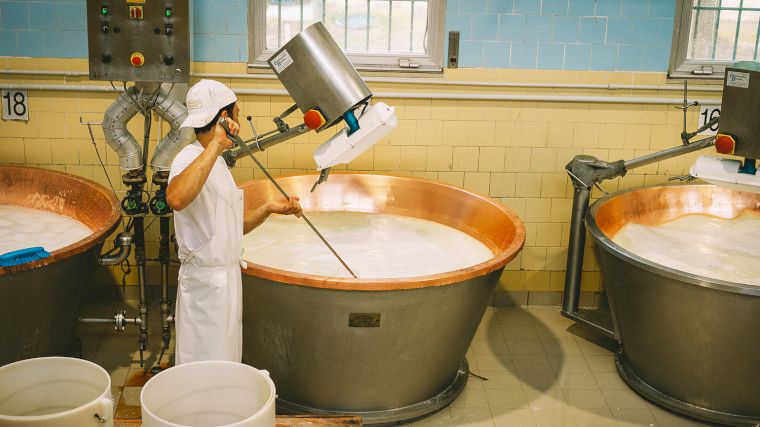
Are you a fan of authentic Parma ham? Then you should visit the city between late August and late September, when the Festival del Prosciutto di Parma takes place. You can see how Parmesan cheese (officially: Parmigiano-Reggiano) is made during a guided tour of a cheese factory (caseificio).
8. Rocca Sanvitale / Castles of the Duchy
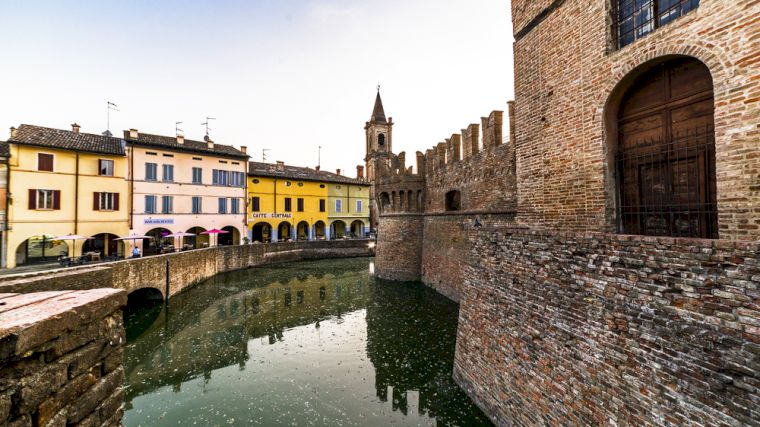
Just northwest of Parma stands one of Italy’s most beautiful castles: Rocca Sanvitale. It is a sturdy fortress, surrounded by a wide moat, originally built in the 12th century and significantly expanded in later centuries. The various halls and rooms surrounding the courtyard are beautifully decorated with frescoes. The charming medieval village of Fontanellato was built around the castle.
In the Middle Ages, every wealthy family lived in its own castle, and the area between Parma and Piacenza is full of them. If you’re interested in this, you can follow a special castle route: Castelli del Ducato, or the Dukes’ Castles. You can create your own itinerary and choose from more than twenty castles.
9. Castello di Canossa
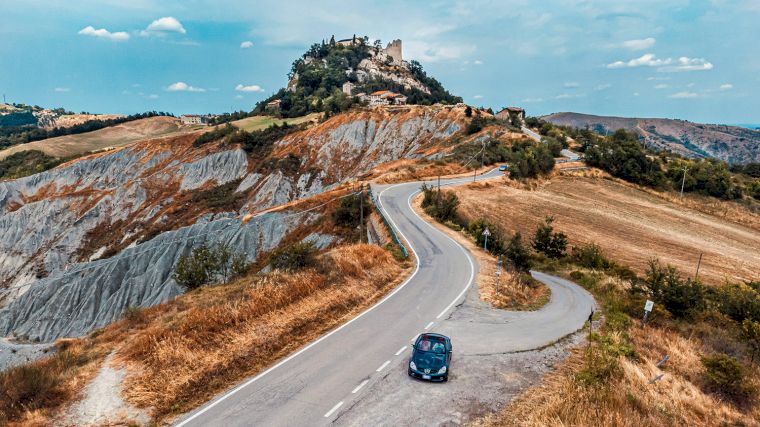
Another such castle is the Castello di Canossa, but all that remains of this 10th-century castle is a ruin. It is, therefore, the surrounding area that is truly breathtaking. On the way to the castle, you’ll drive your rental car past remarkably jagged rock formations, which you can see clearly once you’re at the top of the hill. To take this unique road, you only need to veer slightly off the fastest route between Parma and Modena, as the castle is located about twenty kilometers south of the A1 highway.
10. Terra dei Motori
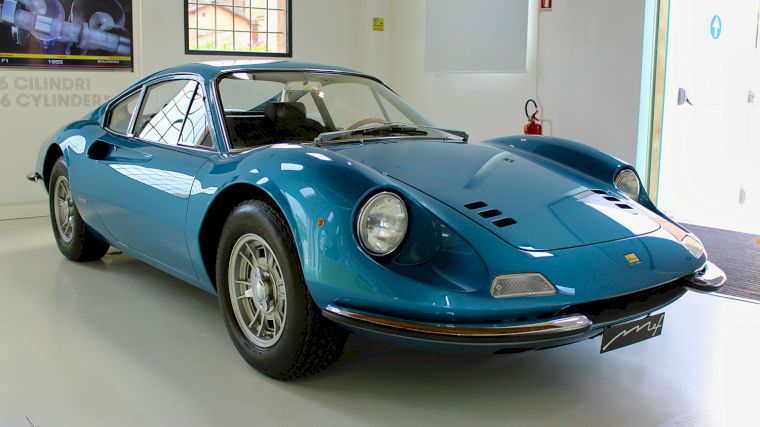
Modena is the heart of the luxury car industry. The city’s most famous son is the founder of Ferrari, but other luxury brands such as Maserati and Lamborghini also have their roots in the Valley of Motors (Terra dei Motori), which stretches from Parma to the Adriatic coast.
The Maserati factory is located in Modena, and during a 1.5-hour guided tour, you’ll visit not only the showroom but also the assembly line and the testing and finishing areas. In that same city, Enzo Ferrari’s home and workshop are now a museum dedicated to his life and work. The other Ferrari museum, featuring both old and new models, is located in the suburb of Maranello, near the car manufacturer’s headquarters. Motorcycle enthusiasts shouldn’t miss the Ducati Museum, across from the Bologna airport.
11. Bologna
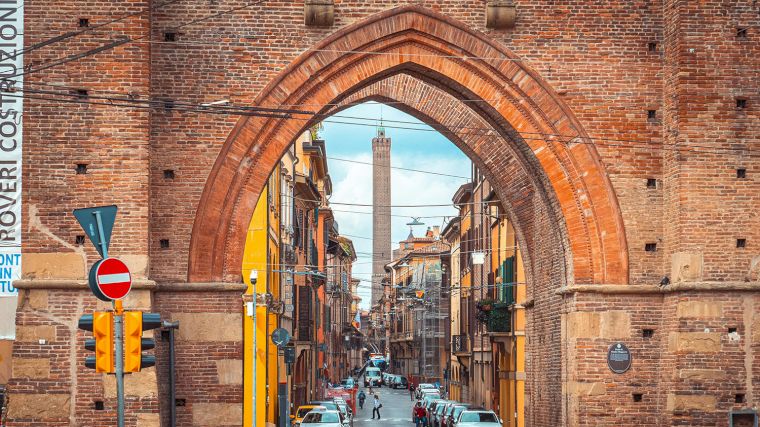
The oldest university in the world is located in Bologna. Founded in 1088, this university has approximately 80,000 students, making Bologna a very lively and welcoming city set against a beautiful historic backdrop. The city center boasts an immense wealth of monuments from the Middle Ages and the Renaissance. Bologna is also known for its extensive network of elegant porticos (covered walkways), allowing you to walk long distances while sheltered from the sun and rain. The two leaning towers— the 97-meter-tall Asinelli and the 48-meter-tall Garisenda —are the city’s symbols.
As the capital of the agricultural region of Emilia-Romagna, there is no shortage of fresh produce in Bologna. Nowhere is this more evident than in and around Via Pescherie Vecchie (Old Fish Market Street), where you can buy fresh pasta, seafood, cheeses, cured hams, and many other delicacies. And of course, the city is famous for Bolognese sauce, which is meant to be eaten with tagliatelle, not spaghetti. By the way, it’s not just about the sauce—the pasta is just as important. According to culinary connoisseurs, the pasta in Bologna is the best, because “the farther you get from Bologna, the more water there is in the pasta.” We’d say: try it for yourself at one of the city’s many trattorias.
12. Valle del Panaro
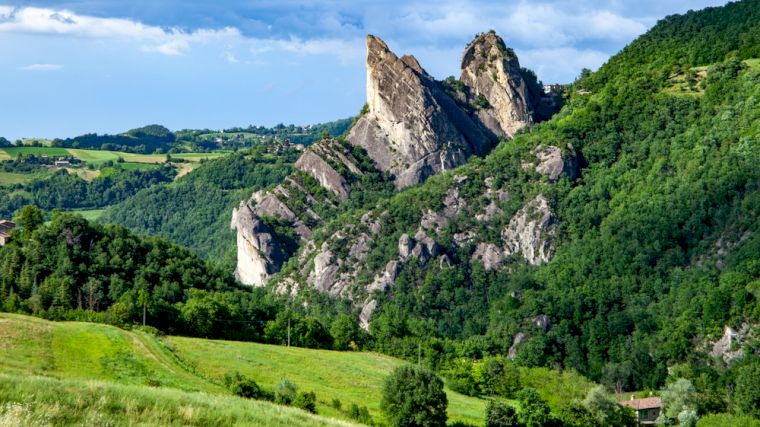
On the way to Florence, we’ll take another detour. Drive 40 kilometers west from Bologna to Vignola. This small town is known for the delicious cherries and plums grown in the surrounding area. Vignola itself also has a few sights worth seeing, including the imposing Rocca Castle and the Palazzo Barozzi, which features a unique spiral staircase.
From Vignola, take your rental car along the SP4 through the Panaro River valley. As you climb toward the mountains, the orchards give way to wooded hills and gorges. You’ll pass the Sassi di Roccamalatina, monoliths over seventy meters high with steep cliffs, which stand in stark contrast to the gently rolling landscape around them. It’s an important breeding ground for birds of prey, such as the peregrine falcon.
13. Grotte Soprasasso
You can continue on to the old town of Fanano, but if you turn off onto the SP27 and follow the SP67 from Canevaccia, you’ll reach the Grotte Soprasasso. These aren’t actually caves, but rather rather peculiar hollows in the rocks. Some people compare these spherical cavities and smooth walls to Gruyère cheese or a somewhat irregular beehive. These caves are located near the town of Vergato, and from there it’s a drive of over 100 kilometers to Florence.
14. Florence
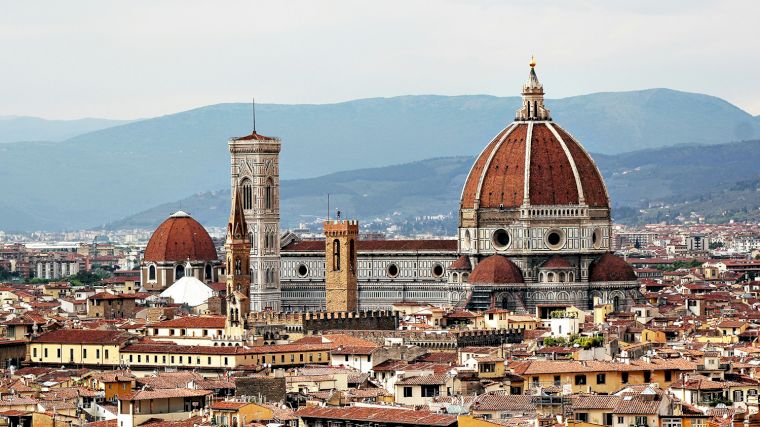
Just like Venice, the world-famous city of Florence needs no introduction. It’s a good idea to figure out in advance where it’s easiest to park your rental car. That will save you a lot of stress when you’re driving toward the historic city center. Parking garages are available at locations such as the Santa Maria Novella train station and beneath Piazza Beccaria. Alternatively, you can drive to the large Villa Costanza parking lot, located along the A1 highway. The tram that departs from there will take you to the center of Florence in just 15 minutes. Please note: park your rental car in the paid section of the lot; the free section is notorious for car break-ins.
Florence (in Italian: Firenze) was one of the wealthiest European cities in the Middle Ages, and you can still clearly see that today. The birthplace of the Renaissance is brimming with history, monuments, and artistic treasures, so be sure to set aside plenty of time to explore this magnificent city. It’s a good idea to book tickets in advance for the Uffizi Museum. Other highlights include the Duomo, the Ponte Vecchio, the Palazzo Vecchio, and the Galleria dell’Accademia. From Piazzale Michelangelo on the south bank of the Arno, you’ll enjoy a breathtaking view of Florence.
EXTRA: Trip through Tuscany to Siena
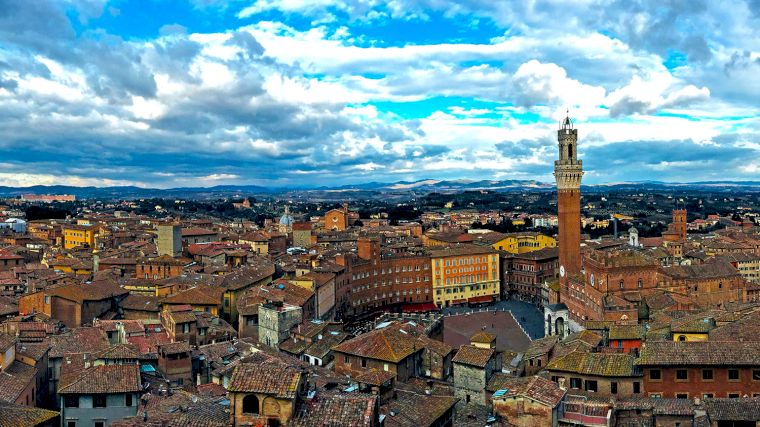
This road trip goes from Venice to Florence, but it would be a shame not to drive a little further south to visit Siena. You’ll drive along winding roads through the heart of Tuscany, with its green rolling hills and cypress trees. That is, unless you take the raccordo autostradale. If there’s one region in Italy where you should stay as far away from the highway as possible during your vacation, it’s Tuscany.
While Florence is the city of the Renaissance, Siena is the city of the Middle Ages. Fortunately, modern developments have largely bypassed the historic center. Thanks to an abundance of well-preserved old buildings, you’ll be immersed in a medieval atmosphere. Like Florence, Siena is a popular tourist destination, but it’s much smaller—and yet it doesn’t feel crowded at all. Perhaps that’s also due to the vastness of a square like the Piazza del Campo.
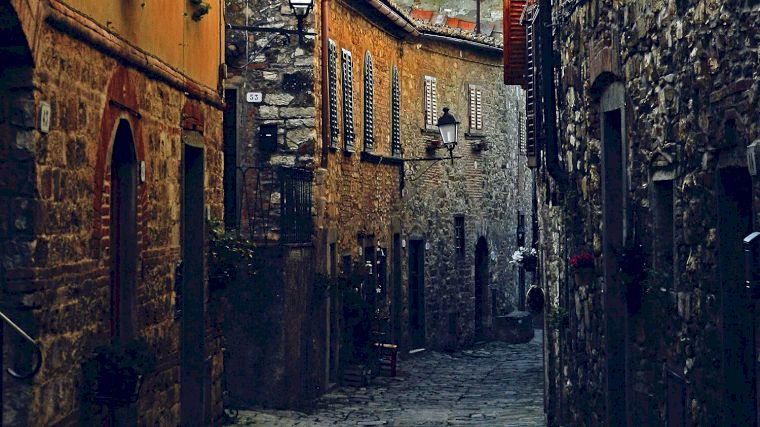
As you drive back to Florence in your rental car, you can take a scenic route through the Chianti Valley, along the panoramic SR222 road past cypress trees, olive groves, and, of course, vineyards. Dotted along the way are charming medieval villages with honey-colored houses, such as Radda, Panzzano, and Greve. Across from the latter village, perched high on a hill, lies the small but picturesque Montefioralle, one of the Borghi più belli d’Italia. In the small wine bars (enotecas), you can sample the region’s wines, including, of course, the fruity Chianti.
EXTRA: Val d’Orcia
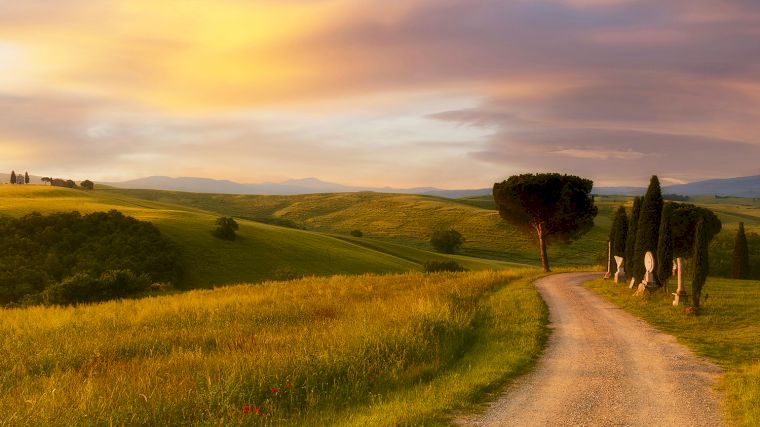
If you drive a little further south, you’ll pass through the Val d’Orcia—the valley with Tuscany’s iconic romantic landscape—southeast of Siena. This area is beautiful in every season, but especially in spring and fall. The landscape looks like a painting, and even if it’s your first time there, it feels as though you’ve been there before. It’s no wonder this area has been captured so often in photographs and paintings. Here, too, you’ll find extraordinary medieval towns and villages, such as Montepulciano. Near San Quirico d’Orcia, you’ll find the famous winding road lined with cypress trees on both sides.
Both in the Chianti region and in the Orcia Valley, there are countless wineries that offer tours and wine tastings. But of course, once you’ve had a glass, you can’t get behind the wheel anymore. Luckily, many of these wineries also offer overnight accommodations! So it’s perfect: drive your rental car to one of these vineyards in a beautiful setting, enjoy the local wines and cuisine, and continue your journey the next day.
Round trip with a rental car or one-way?
If you book a rental car in or near Venice, you’ll face a choice: return it to where you picked it up, or not? From Florence, you can easily drive back via a different route. For example, take the SR302/SP302 toward Ravenna, where you can enjoy panoramic views and take a detour to the karst mountains in the Parco Regionale della Vena del Gesso Romagnola. Then drive from Ravenna back to Venice via seaside towns along the Adriatic coast to return your rental car. Tip: Don’t forget to visit Chioggia, also known as “Little Venice.”
Want to enjoy even more of Tuscany? Of course you can, because we haven’t even mentioned attractions like San Gimignano or cities like Lucca and Pisa yet. You can read all about them in our blog post “7 Day Trips by Rental Car Around Pisa.” You can also enjoy a beach vacation in beautiful surroundings along the Tyrrhenian Sea coast. The wild, natural beaches in the Parco Maremma are an absolute must-see.
You can also opt for a so-called one-way rental, where you return the car to a different location than where you picked it up. For example, the start and end points of the road trip described here, but you can also choose a different destination—such as continuing on to Rome. If you want to visit the world-famous Cinque Terre, Genoa is a great place to return your rental car. To find out what surcharge you’ll pay for a one-way rental, enter a different final destination on our search form. In the results, you’ll then see only the rental cars for which this option is available, along with the amount of the “one-way surcharge.”
Whatever you choose, the main advantage of a rental car is that you can visit places off the beaten path (and away from tourist routes).
Zona á Traffico Limitato
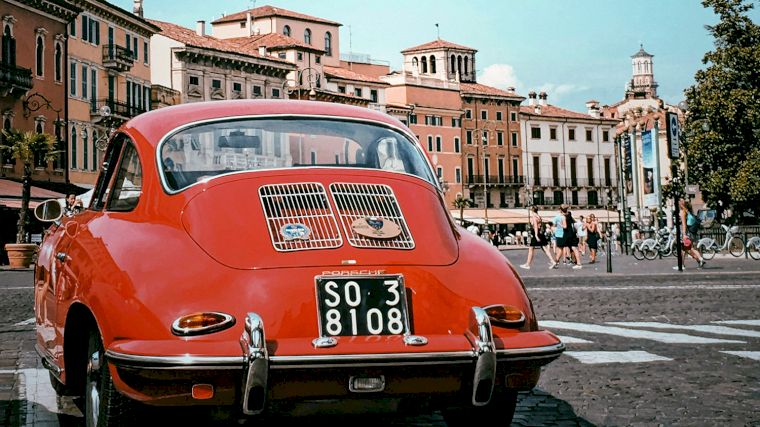
All larger towns, as well as many villages in Italy, have an area where only residents’ and delivery vehicles are allowed—the so-called Zona a Traffico Limitato (ZTL). Sometimes this restriction applies only at certain times, but it’s best never to drive your rental car into such a zone unless you’ve booked accommodations located within the ZTL. Even if you’ve reserved a spot in a parking garage within the ZTL area, your rental car’s license plate number will be entered into the system, allowing you to drive there without any issues. We explain how this works in more detail in our blog post about ZTL zones.

Where would you like to rent a car?
- 24000+ pick-up locations
- Free cancellation
- Independent comparator

Useful tips for a well-prepared trip
Which insurance should I choose, and what's the deal with the deposit? Read our articles with useful information and tips to ensure you choose the right rental car for you.


- Renting a Car with Kids: The Best Routes and Stops
- Flying to a winter sports destination? Rent a car once you arrive
- 14 Best Day Trips by Rental Car from Rome
- 16 places of interest between Naples and Lamezia Terme
- The 11 Most Beautiful Travel Destinations in Southern Italy
- 12 Tips for a Road Trip Starting from Olbia or Alghero