- Popular countries
- Popular regions
- Popular cities
- Popular airports
- Car Rental Italy
- Car Rental Spain
- Car Rental United States
- Car Rental Portugal
- Car Rental South Africa
- Car Rental France
- Car Rental Netherlands
- Car Rental Greece
- Car Rental Germany
- Car Rental United Kingdom
- Car Rental Belgium
- Car Rental Croatia
- Car Rental Switzerland
- Car Rental Austria
- Car Rental Denmark
- Car Rental Norway
- Car Rental Australia
- Car Rental Ireland
- Car Rental Cyprus
- Car Rental Canada
- Car Rental Florida
- Car Rental Sicily
- Car Rental California
- Car Rental England
- Car Rental Sardinia
- Car Rental Mallorca
- Car Rental Ibiza
- Car Rental Crete
- Car Rental Tenerife
- Car Rental Rhodes
- Car Rental Madeira
- Car Rental Corsica
- Car Rental Gran Canaria
- Car Rental Malta
- Car Rental Scotland
- Car Rental Azores
- Car Rental Fuerteventura
- Car Rental Lanzarote
- Car Rental Corfu
- Car Rental Zakynthos
- Car Rental Amsterdam
- Car Rental Milan
- Car Rental Miami
- Car Rental Lisbon
- Car Rental Malaga
- Car Rental Porto
- Car Rental Rome
- Car Rental Cape Town
- Car Rental Barcelona
- Car Rental Faro
- Car Rental Alicante
- Car Rental Nice
- Car Rental Bari
- Car Rental Naples
- Car Rental Johannesburg
- Car Rental Brussels
- Car Rental Bergamo
- Car Rental Orlando
- Car Rental Palma de Mallorca
- Car Rental Vienna
- Car Rental Amsterdam Schiphol Airport
- Car Rental Miami International Airport
- Car Rental Lisbon Airport
- Car Rental Malaga Airport
- Car Rental Porto Airport
- Car Rental Milan Malpensa Airport
- Car Rental Rome Fiumicino Airport
- Car Rental Faro Airport
- Car Rental Alicante Airport
- Car Rental Bari Palese Airport
- Car Rental Nice Airport
- Car Rental Barcelona Airport
- Car Rental Cape Town Airport - International Terminal
- Car Rental Bergamo Airport
- Car Rental Orlando International Airport
- Car Rental Mallorca Airport
- Car Rental Catania Airport
- Car Rental Johannesburg International Airport
- Car Rental Ibiza Airport
- Car Rental Athens Airport

Sardinia by Rental Car: Culture, Nature, and Beaches
Rent a car for a road trip from Cagliari
The Italian island of Sardinia is perfect for a road trip in a rental car. You don’t need one to visit the cultural gems of Cagliari, but you will if you want to see more of the island’s southern region. And who wouldn’t want to do that? If you rent a car, you can fully enjoy the spectacular coastline, prehistoric nuraghi, and other ancient ruins surrounded by rolling hills covered in maquis, limestone mountains, deep ravines, and, of course, charming towns and villages.
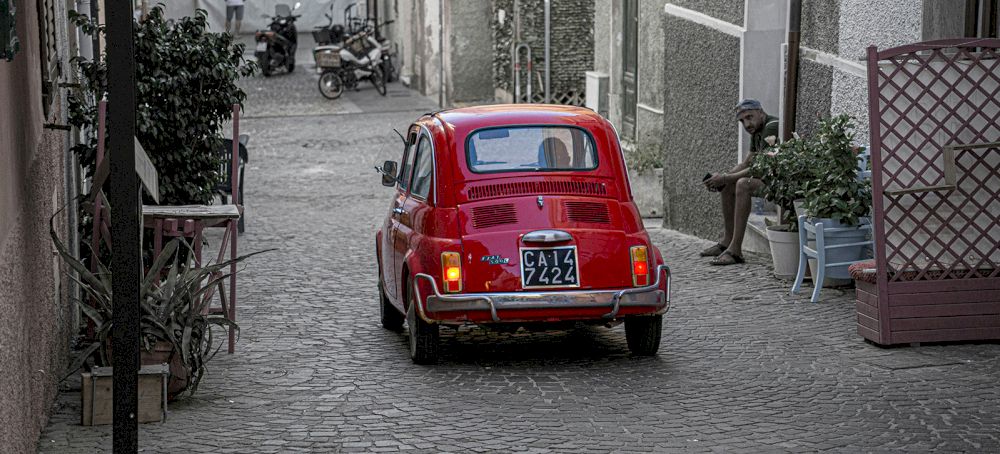
Below, we describe a trip that first takes you through southwestern Sardinia and then through the mountainous heart of the island to the east coast and back to the capital. Unlike Sicily, Sardinia has vast uninhabited and remote areas with rugged landscapes. If you take the time to soak in the beautiful nature and visit the sights, you’ll need about two weeks for this road trip. But you can make the trip as long or as short as you like, since you’ve rented a car. That gives you complete freedom to plan your own itinerary. Are you just looking for the most beautiful beaches in southern Sardinia? We’ve got you covered there, too!
Cagliari
As mentioned above, you don’t need a rental car in Cagliari. In fact, driving around the city is not recommended, as it has several ZTLs (zona a traffico limitato), and the best sights and viewpoints are located precisely within those zones. Sardinia’s capital is built on hills, and the golden-hued palazzi seem to rise right out of the Mediterranean Sea. The dome of the 13th-century Cattedrale di Santa Maria towers above it all. You can wander for hours through the city’s historic center. Be sure to visit the Museo Archeologico Nazionale to learn more about Nuragic culture, whose remains you’ll encounter frequently during this tour. For the most beautiful view, head to the Bastione San Remy, a monumental observation deck.
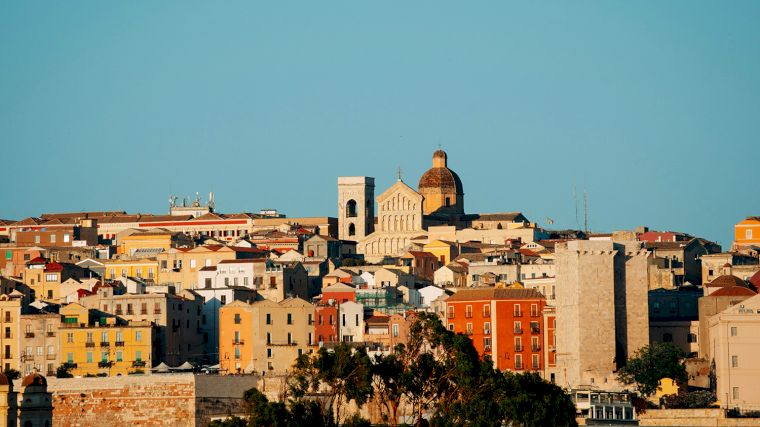
Are you already itching to take a dip in the sea? Just a short distance east of the city center lies the long, wide sandy beach of Poetto. The water here can be quite cold, and the strong wind can sometimes be a bit of a downer.
Pula
From Cagliari, take the SS195 southwest. Just outside the city, this road cuts right through a lagoon, where you can often spot flamingos, especially in late spring and summer. Pula is less than forty kilometers from Cagliari, so it’s a short drive in your rental car. The town is a good base for exploring the archaeological site of Nora on a small peninsula near the modern village of the same name. It was already a powerful settlement as early as the ninth century B.C., founded by the Phoenicians. Today, the most striking remains date from the Roman period, such as the amphitheater, magnificent mosaic floors, and a bathhouse.
Just before you reach the ruins of Nora, you’ll see a small 12th-century Romanesque church, the Chiesa di Sant’Efisio, which stands practically on the beach. That little beach is nice, but for truly beautiful beaches, you’ll need to drive further southwest.
Costa del Sud and Strada Panoramica
As early as the village of Santa Margherita di Pula, you’ll find beautiful beaches, such as Calaverde and Pinus Village, but even more beautiful beaches lie near Chia a little further on: Spiaggia Sa Colonia and the smaller Spiaggia Su Portu. Prefer to stretch your legs rather than lie on the beach? Between Pinus Village and Chia, there’s a very scenic path along the coast, the strada romana.
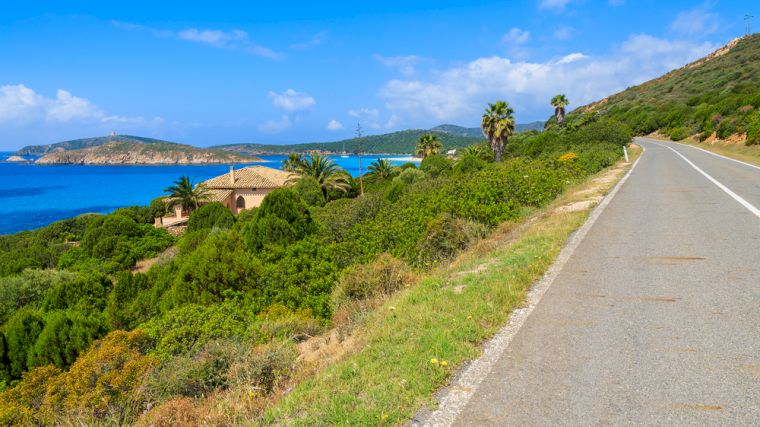
The Costa del Sud stretches from Chia to Teulada and is one of the most beautiful stretches of coastline in southern Sardinia. A delightful road (SP71) runs along it—perfect for driving in your rental car! This road, over 25 kilometers long, is one of Italy’s “strade panoramiche ”: a stunning drive with dreamy views around every bend. The road constantly winds up and down alongside a clear blue sea and many small white beaches that beg you to stop for a moment. You’ll also see watchtowers dating back to the time when Spain ruled Sardinia. Just be mindful of motorcyclists and cyclists, who also find this a wonderfully challenging road.
Tratalias / Sant’Antioco
From Teulada, it’s a drive of over forty kilometers to the town of Sant’Antioco on the small island of the same name off the southwest coast of Sardinia. You’ll pass through Tratalias Vecchia, which is definitely worth a stop. It’s an abandoned medieval town centered around a beautiful Romanesque church. This 13th-century church, the Chiesa di Santa Maria di Monserrato, stands in the heart of the borgo antico, a neighborhood that has been uninhabited since the 1980s but remains well-preserved, with a few restored houses.
In your rental car, you’ll drive across a spit of land and a bridge to the lively town of Sant’Antioco. Like so many other places on the island, it was founded by the Phoenicians long before the start of our era, as the settlement of Sulki. You can see what it looked like some 2,500 years ago in a scale model at the Archaeological Museum. The museum is part of the Parco Storico Archeologico, which features a fascinating collection of local artifacts as well as models of Nuragic houses. In the park, you’ll find the remains of an acropolis and a well-preserved necropolis.
On the island’s west coast, just past the resort village of I Ciclopi, you’ll find a large parking lot where you can leave your rental car to hike down to the rocky cove of Cala della Signora. You can swim or snorkel there, but there isn’t a real beach. Be sure to wear water shoes, as the rocks aren’t the easiest to walk on. Further south, you’ll find the Grotta delle Sirene (Mermaid’s Cave). As the name suggests, this cave is quite difficult to reach by land—and certainly not by rental car—since there are only hiking trails. But the hike itself is beautiful, as you’ll always have a view of the sea while walking through dense, fragrant shrubbery.
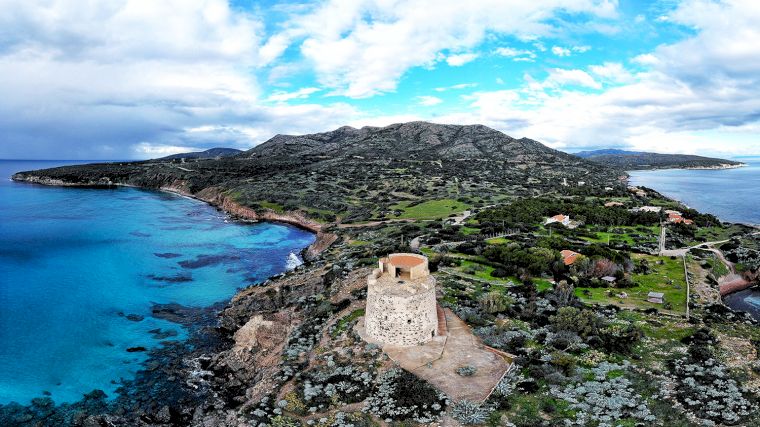
At the northernmost tip of the island lies Calasetta, a fishing village with colorful houses, dominated by the Torre Sabauda. This tower was built in the 18th century to defend the passage between Sant’Antioco and the island of San Pietro against pirates. Close to the village is Sottotorre Beach, which can get quite crowded. Alternatives include Spiaggia La Salina and Spiaggia Grande, which are a bit further away. Calasetta has a ferry service to the smaller island of San Pietro, but cars are not allowed on the ferry.
Isola di San Pietro
If you want to drive your rental car to San Pietro, you’ll need to drive back to the mainland and take the ferry from Portovesme. You’ll arrive in Carloforte, the elegant little town with a charming promenade lined with restaurants, cafés, and outdoor seating areas. You’ll also find many inviting eateries in the cobblestone side streets with their colorful houses.
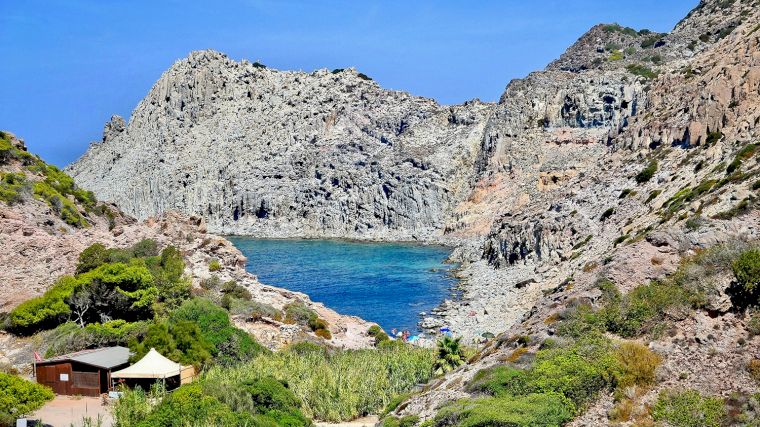
San Pietro is known for its rugged coastal rock formations. Take a drive along the coastal roads and you’ll come across stunning viewpoints. For example, at Capo Sandalo on the west coast. From the parking lot near the lighthouse, marked hiking trails lead through the reddish scrub that covers the cliffs. Just like at La Caletta further south, you can enjoy a beautiful sunset there.
Porto Flavia / Iglesias
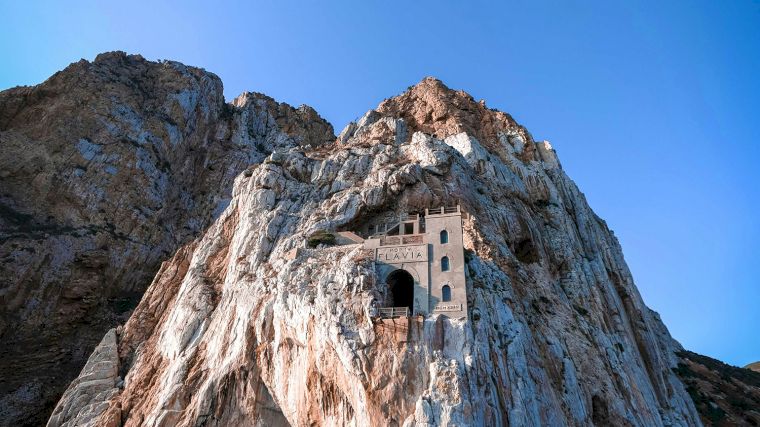
Between Portovesme and Iglesias, you’ll drive through the former mining heart of Sardinia. That might not sound like much of a sightseeing spot, yet there are beautiful things to see that remind you of this past. For example, just before you reach Iglesias, turn left and take the SP83 to Masua. Near this village lies the Porto Flavia museum, a former port carved into the cliffs fifty meters above sea level, with a network of mine shafts behind it. It’s an engineering marvel built in 1924 to load lead and zinc ore directly from the mine onto ships. Guided tours are offered every hour.
Iglesias has a slightly Spanish feel to it, a legacy from the time when Sardinia was a Spanish colony. The large church in the old town, the Cattedrale di Santa Chiara d’Assisi, is, however, typically Italian, as it dates back to the thirteenth century, when the Republic of Pisa ruled the region. The historic center is incredibly charming and makes for a great stopover during your tour of the island.
East of Iglesias, you’ll find the vertical limestone cliffs of Domusnovas. This is a climber’s paradise, perfect for both beginners and advanced sport climbers. You can also visit many caves in this area, such as Grotta San Giovanni, and admire waterfalls, including Cascata di Piscina Irgas.
Fluminimaggiore
From Iglesias, the SS126 winds through wooded hills toward Fluminimaggiore. Along the way, you’ll pass several points of interest. First, there’s a turnoff to the Punic-Roman Temple of Antas, the remains of a third-century Roman temple with Ionic columns, built on the ruins of a Punic sanctuary.
Five kilometers further along the winding route, there’s a major side road leading to the Grotta di Su Mannau, where you can walk along well-maintained trails past stalactites and stalagmites. Besides being a beautiful sight to see, the cave also offers a welcome cool respite from the high summer temperatures.
A little further on, there’s a turnoff to the sorgenti di Pubusinu. From the parking lot, about 400 meters from the main road, there are several hiking trails through this beautiful former mining area with natural freshwater springs. There are also picnic tables at various spots, so you can enjoy a nice lunch out in nature. You can also do this at the Giardino Su Zurfuru, just before you enter Fluminimaggiore.
In that village, the old watermill (vecchio mulino ad acqua) is now a small but interesting ethnographic museum.
Dune di Piscinas
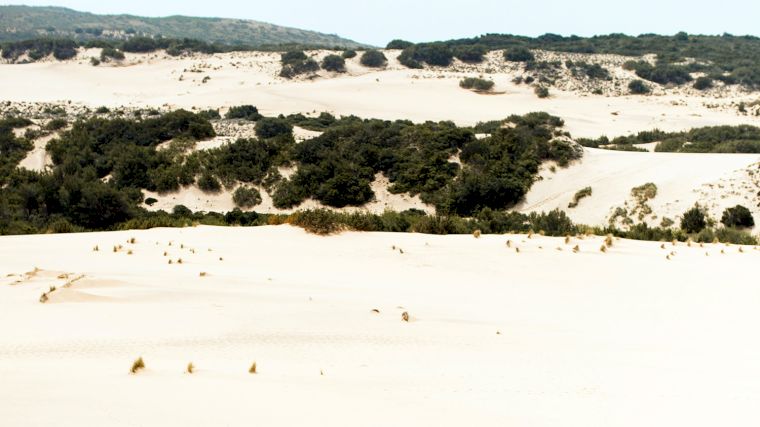
Looking for a wide but quiet sandy beach? Then Dune di Piscinas is the place for you! There’s just one downside: the drive there isn’t the easiest, which is why this beautiful beach isn’t very crowded. To get there, take your rental car from Fluminimaggiore and head north on the SS126. After about fourteen kilometers, you’ll see the turnoff for Piscinas. You’ll drive along a very winding road, and the final stretch through the dune area is gravel. So drive slowly to avoid damage from flying gravel. After crossing a very narrow bridge—just wide enough for one car—you’ll arrive at the spacious parking lot and the stunning beach. The dune area behind it is enormous, and you can take beautiful walks there.
The beach is located roughly in the middle of the Costa Verde (Green Coast), a fifty-kilometer-long coastal strip with unspoiled dunes and sandy beaches. The beach near the village of Pistis is easier to reach than Piscinas. Near the village itself, the beach is quite rocky, but a little further south, the long sandy beach begins.
Laconi / Su Nuraxi di Barumini
Piscinas is part of the municipality of Arbus, and from there it’s about an hour and a half’s drive to Laconi, a quiet mountain town surrounded by green forests. In picturesque Laconi, the Menhir Museum is the main attraction, featuring a unique collection of forty monolithic menhirs (perdas fittas). These upright stones, dating back some five thousand years, were likely associated with burial rituals.
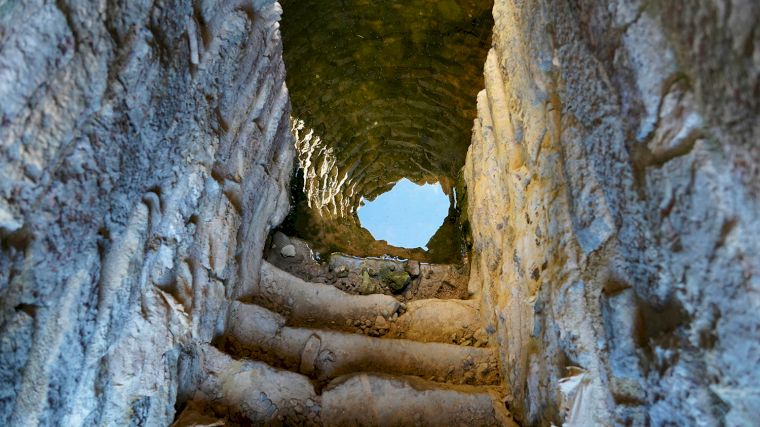
From Laconi, it’s about a 25-kilometer drive to a must-see attraction in Sardinia: Su Nuraxi di Barumini. It’s an archaeological site featuring the best-preserved towers of the Nuragic culture. The ruins offer a unique glimpse into history. The towers, situated above sacred springs, are built from enormous stones placed close together in the tholos style, with narrow tunnels running between them. Be prepared for a short wait, as only one group at a time is allowed to enter or exit the main building. Please note: if it’s raining or has recently rained, the complex is often closed because the ground becomes too slippery and therefore dangerous. So be sure to check the weather forecast before driving there in your rental car.
Laconi is located near the Gennargentu National Park, which, incidentally, has a very rugged terrain and extends all the way to the coastal strip between Dorgali and Baunei. Covering 74,000 hectares, this is Sardinia’s largest nature park, featuring, among other things, the deep Gola Su Gorropu gorge and the island’s highest peak, Punta La Marmora (1,834 m). For routes to the highest and deepest points of the national park, see our blog about northern Sardinia.
Ogliastra / Costa Baunei
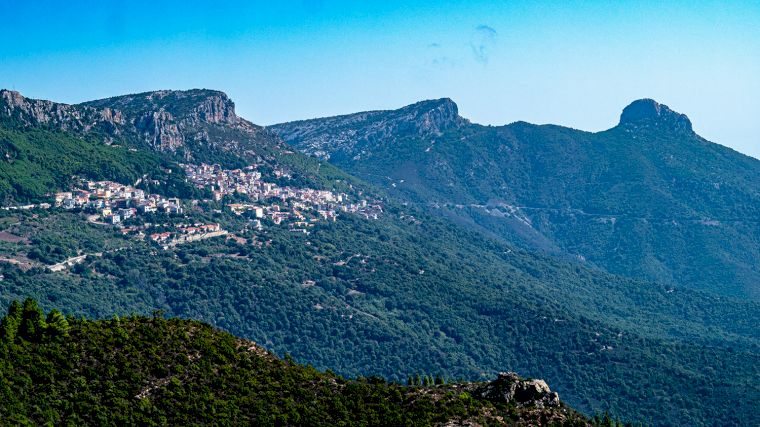
You’ve got to love winding roads if you’re driving east from Laconi in your rental car. The first stretch—along the SP52bis and SP52—isn’t too bad in terms of curves. Just past Villanova Tulo, this road connects to the much more winding SS198, which runs along Lago Basso del Flumendosa. The hills surrounding this reservoir are dotted with countless nuraghi. There are also plenty of opportunities to spend the night at an agriturismo, where you can experience authentic country life.
Further east, you’ll pass through the historic region of Ogliastra, best known for its stunning wild coastline of cliffs and bays. But first, you’ll drive through the region’s interior, where you’ll find gems of history and tradition. It’s one of the least densely populated areas in all of Italy, and every village has its own customs. Seui, Lanusei, and Baunei are just a few of the villages that will enchant you with their ancient churches, quaint houses, and spectacular views of the surrounding valleys and mountains—which also invite you to explore on foot.
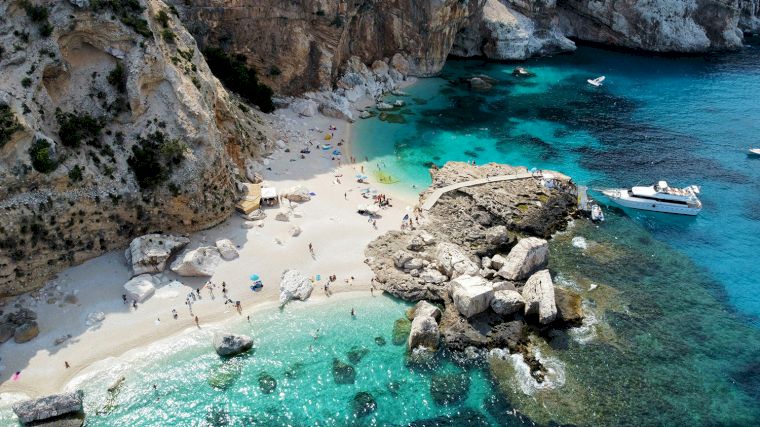
The SS198 ends in Tortolì, where it connects to the SS125. If you follow that road north, you’ll experience one of Italy’s most beautiful driving routes. You can read more about it in our blog post with tips for northern Sardinia. Another way to admire the coast here in all its dramatic beauty is to rent a boat in Arbatax. The Costa di Baunei consists of steep limestone cliffs rising from turquoise waters, interspersed with mysterious caves, such as Grotta dei Colombi, and small coves. In those coves, you’ll find nearly hidden beaches that are most easily accessible by boat. You can also reach some of these beaches by land, but walking for hours in the heat isn’t pleasant.
Quiet beaches on the east coast
From Tortolì southward, the SS125 and SS125var run through a sort of no man’s land, where hardly anyone lives. Note: the faster, newer road is the SS125var; the old road does not have the “var” suffix. If you’re not in a hurry, we recommend taking the old road, which is just as well maintained as the new one. Take a side road every now and then if you want to enjoy a (quiet) beach, for example near Tertenia, where you can drive your rental car to Spiaggia di Foxi Manna, or near Quirra to Spiaggia di Murtas.
A little further south, near the charming town of Muravera, you’ll find expansive beaches, including the narrow but incredibly long Spiaggia di San Giovanni. You can always find a quiet spot there, even in high season. The (old) SS125 runs right past here, and there’s a parking lot right by the beach.
Costa Rei / Villasimius
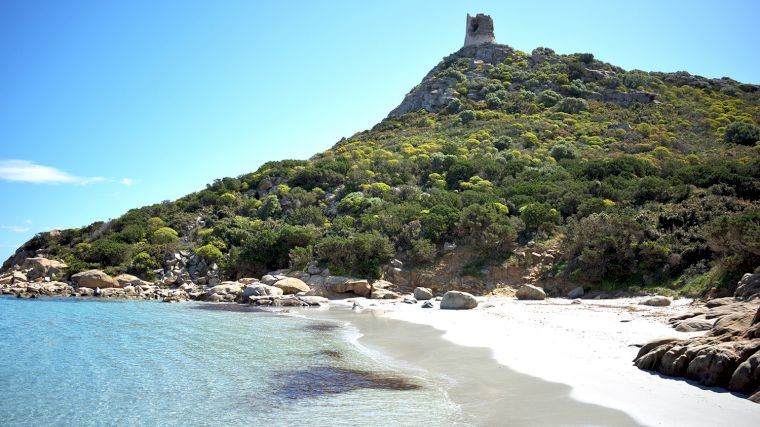
Further south, you’ll reach the Costa Rei, with its incredibly long sandy beaches. Some sections are packed with lounge chairs and umbrellas during the summer months, but you can still find quiet spots here—though you’ll often have to walk a bit to get there.
Near Villasimius, you’ll find the beautiful Spiaggia di Porto Giunco, which forms the boundary between the Tyrrhenian Sea on one side and a lagoon on the other. From the smaller beach at Capo Carbonara, just south of it, you can take a lovely walk along the cape of the same name. A narrow path leads up the hill from the parking lot. After a short stretch along the unpaved road, the hiking trail begins, offering fantastic views of the sea to the left and right of the small peninsula. You can take a boat tour to explore the underwater world around the cape, which is a protected marine area.
Via Cagliari (SP17)
You’ll remember the drive back to Cagliari for a long time, as it’s another amazing route right along Sardinia’s southern coast. From Villasimius, follow the SP17 to the capital. The route is forty kilometers long and, at a normal speed, takes about an hour. But trust us: it’ll take you much longer. What fabulous views, what lovely little beaches, what a delightful road. Now that’s a fitting finale to an unforgettable road trip through southern Sardinia. The road ends at Quartu Sant’Elena and Spiaggia del Poetto beach. Settle in and savor the memories!
Explore the 9 best beaches in southern Sardinia by rental car
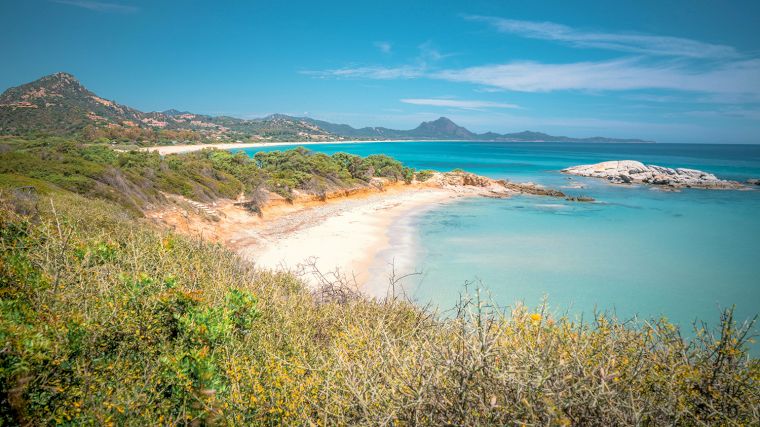
You often hear that the most beautiful beaches are in northern Sardinia. But as we’ve mentioned a few times above, there are also some absolute gems to be found in the south. Are you a true beach lover? Then here’s our list of the 9 most beautiful beaches in southern Sardinia. We’ll go clockwise, starting on the east coast and ending in the middle of the west coast. In compiling this list, we’ve made sure that you can reach the beaches by rental car. The (often equally beautiful) small coves accessible only by boat are therefore not included here.
1. Beaches near Lido di Orrì
These beaches are located just south of Arbatax and feature a mix of sand and large boulders. In the far south (Spiaggia Dei Milanesi), there are even beaches consisting entirely of boulders, which make for great snorkeling. The beaches near the seaside resort of Lido di Orrì have lovely fine sand, and parking fees for your rental car are low.
2. Beaches of Costa Rei
Here, too, there isn’t just one beach, but several beaches that together form the Costa Rei, between the Capo Ferrato nature reserve in the north and the seaside town of Sant’Elmo in the south. In between lies Punta Di Santa Giusta. The gently sloping beach is ideal for small children, and during the summer months, there are plenty of activities organized for the little ones.
3. Punta Molentis
Near Villasimius in southeastern Sardinia, there are several beautiful beaches and coves (see above), but Punta Molentis stands out. It’s a narrow strip of land connected to a rocky peninsula, so you’re surrounded by the sea on both sides. The west side is sandy, while the east side consists of large boulders—perfect for scrambling over—just like the climb to the highest point on the peninsula.
4. Tuerredda Beach
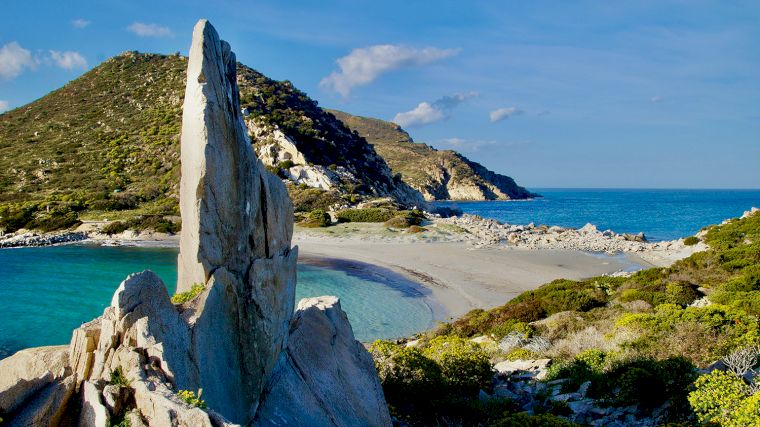
If you don’t like crowds, you’re better off skipping this beach, because Tuerredda is very popular. It’s not hard to see why: it’s a beautiful white-sand beach that curves around a headland and is very easy to reach via the SP71. If you drive about five hundred meters east on that road, you’ll come to a small parking lot, where a path leads to a smaller beach that’s much quieter.
5. Spiaggia Dune Bianche
Near Porto Pino lies a beach bordered by tall white sand dunes. The contrast between the bright white sand of the dunes and the azure-blue water of the sea is phenomenal. Behind the beach is a fairly large lagoon, where you can sometimes (but not always) spot flamingos. Oh, and of course, you can also just relax on the beach and swim in the sea.
6. Spiaggia Coaquaddus
On the small island of Sant’Antioco, Maladroxia is often cited as the most beautiful beach, but the lesser-known Coaquaddus is just as lovely. The name means “ponytail” in the Sardinian dialect, referring to its winding shape. The beach is divided in two by a small rock formation, a favorite spot for snorkelers.
7. Cala Fico Beach
Not everyone drives a rental car to the smaller island of San Pietro, but if you do, Cala Fico on the west coast is highly recommended. It’s a pebble cove with crystal-clear water, surrounded by tall cliffs. It’s not very crowded, since you have to descend a rocky path to reach the beach. From the parking lot, you can also turn off toward Capo Sandalo for fantastic hikes and views.
8. Cala Domestica
Just south of Buggeru lies an intimate cove, sheltered by high limestone cliffs on both sides. Is the sea too rough? Then you can also head to a natural pool, l’occhio di Giulia, near the Spanish watchtower on the rock along the left side of the cove. It’s also a lovely spot for beautiful views and to enjoy the sunset.
9. Dune di Piscinas
We already mentioned this beach above, but we’re including it in this list to draw extra attention to it. This is for people who love vast, open spaces: you’ll hardly see anyone, either on the beach or in the dune area behind it. That’s mainly because this stretch of coast is a bit harder to reach (via a dirt road), but it’s quite doable with a rental car.
Driving a Rental Car in Sardinia
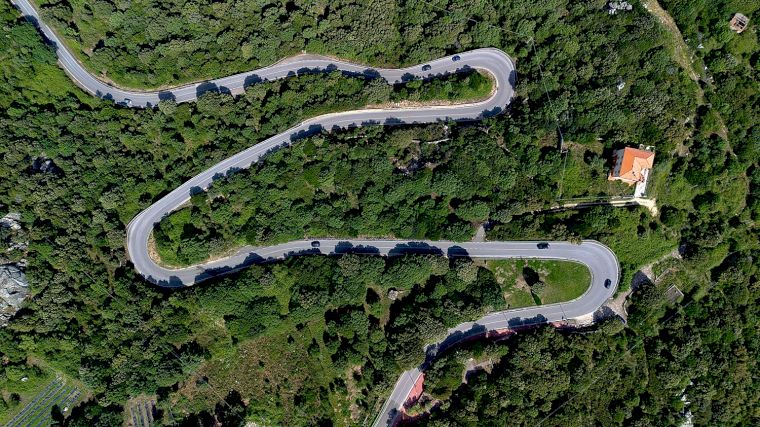
Sardinia is something of an outlier within Italy, as it is the only region without highways. However, the roads are excellent and connect all the major towns. Sardinia is mountainous, so as soon as you leave the main roads, you’ll encounter curves. Lots of curves. And some of them are quite sharp. These roads are a lot of fun to drive on, and you’ll enjoy stunning views, but you’ll also get tired more quickly. So be sure to take plenty of breaks—and finding a spot to rest is really not hard on the incredibly beautiful island of Sardinia. It’s also nice if you can take turns driving the rental car. If you rent a car with an additional driver, you can both take turns fully enjoying the scenery. As you head further inland, roads may be unpaved. Always drive slowly there to avoid stone chips. Also, in the interior, animals may be on the road, especially sheep and goats.
Make sure your tank is full before you set out on a trip in Sardinia. You wouldn’t be the first to realize a little too late, out in the vast, uninhabited interior, that the next gas station isn’t another fifty kilometers away.
When to Rent a Car in Sardinia
Although large parts of Sardinia are virtually uninhabited and attract few tourists, many beaches are crowded during the summer months. Still, you can find quiet spots even then, as we described above. If you have the option, spring and fall are ideal times to visit Sardinia: beautiful blooms in the spring and fewer crowds, but still warm in the fall. No matter when you go, you’re sure to enjoy Sardinia—especially if you explore it in a rental car.

Where would you like to rent a car?
- 24000+ pick-up locations
- Free cancellation
- Independent comparator

Useful tips for a well-prepared trip
Which insurance should I choose, and what's the deal with the deposit? Read our articles with useful information and tips to ensure you choose the right rental car for you.