- Popular countries
- Popular regions
- Popular cities
- Popular airports
- Car Rental Italy
- Car Rental Spain
- Car Rental United States
- Car Rental Portugal
- Car Rental South Africa
- Car Rental France
- Car Rental Netherlands
- Car Rental Greece
- Car Rental Germany
- Car Rental United Kingdom
- Car Rental Belgium
- Car Rental Croatia
- Car Rental Switzerland
- Car Rental Austria
- Car Rental Denmark
- Car Rental Norway
- Car Rental Australia
- Car Rental Ireland
- Car Rental Cyprus
- Car Rental Canada
- Car Rental Florida
- Car Rental Sicily
- Car Rental California
- Car Rental England
- Car Rental Sardinia
- Car Rental Mallorca
- Car Rental Ibiza
- Car Rental Crete
- Car Rental Tenerife
- Car Rental Rhodes
- Car Rental Madeira
- Car Rental Corsica
- Car Rental Gran Canaria
- Car Rental Malta
- Car Rental Scotland
- Car Rental Azores
- Car Rental Fuerteventura
- Car Rental Lanzarote
- Car Rental Corfu
- Car Rental Zakynthos
- Car Rental Amsterdam
- Car Rental Milan
- Car Rental Miami
- Car Rental Lisbon
- Car Rental Malaga
- Car Rental Porto
- Car Rental Rome
- Car Rental Cape Town
- Car Rental Barcelona
- Car Rental Faro
- Car Rental Alicante
- Car Rental Nice
- Car Rental Bari
- Car Rental Naples
- Car Rental Johannesburg
- Car Rental Brussels
- Car Rental Bergamo
- Car Rental Orlando
- Car Rental Palma de Mallorca
- Car Rental Vienna
- Car Rental Amsterdam Schiphol Airport
- Car Rental Miami International Airport
- Car Rental Lisbon Airport
- Car Rental Malaga Airport
- Car Rental Porto Airport
- Car Rental Milan Malpensa Airport
- Car Rental Rome Fiumicino Airport
- Car Rental Faro Airport
- Car Rental Alicante Airport
- Car Rental Bari Palese Airport
- Car Rental Nice Airport
- Car Rental Barcelona Airport
- Car Rental Cape Town Airport - International Terminal
- Car Rental Bergamo Airport
- Car Rental Orlando International Airport
- Car Rental Mallorca Airport
- Car Rental Catania Airport
- Car Rental Johannesburg International Airport
- Car Rental Ibiza Airport
- Car Rental Athens Airport

Traffic Rules in Spain: What Rental Car Drivers Need to Know
Plus tips for driving a rental car in Spain
Last updated: July 14, 2026
Spain drives on the right and has traffic rules similar to those in other European countries, but there are five points that can cause confusion: speed limits in urban areas, applicable blood alcohol limits, required items in the car, ZBE environmental zones, and the colors of parking zones. We’ll tell you everything you need to know about driving a rental car in Spain.
On this page:
Overview of Spanish Traffic Rules
| Rule | Spanish standard | Fine |
|---|---|---|
| Speed | • autopistas/autovías:120 km/h • other roads outside built-up areas:90 km/h • within built-up areas: • more than 1 lane:50 km/h • 1 lane:30 km/h • residential areas:20 km/h |
€100 – €600 |
| Alcohol | • Experienced
drivers:0.5
‰ • novice drivers (less than 2 years with a driver’s license):0.3‰ |
€500 – €1,000 |
| Low beams | • during the day in poor visibility and in tunnels • during the day on lane-change lanes (direction of travel changes) |
€200 |
| Cell phone | • Hands-free calling only | Starting at €200 |
| Safety | • Safety vests + V16 emergency signal light • Always keep both hands on the steering wheel • Headphones or earbuds are prohibited |
€80 – €200 |
| Child seat | • Required for children under 135 cm or under 12 years of age | €200 |
| Right of Way | • thick, broken white line:
right-of-way road • traffic on roundabouts has the right of way |
€200 |
| Cyclists | • When passing cyclists, maintain a minimum distance of 1.5 meters | €200 |
The 10 Most Important Traffic Rules in Spain
1. Speed Limits
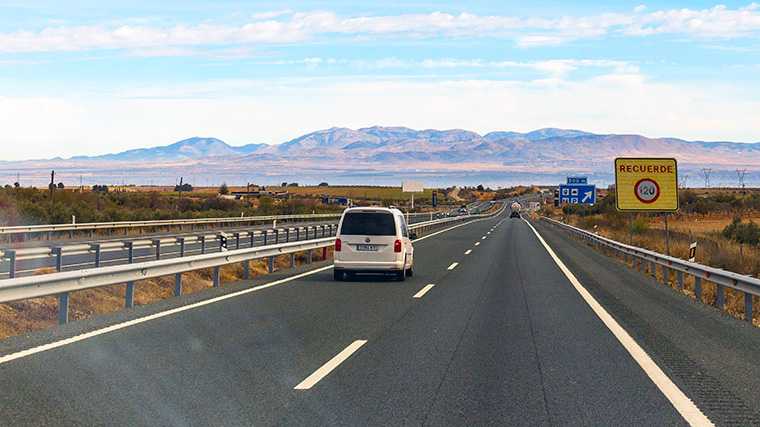
On Spanish autopistas and autovías (highways), the speed limit is 120 km/h; on other roads outside built-up areas, it is 90 km/h, and sometimes 100 km/h on two-lane roads that are not classified as autovías. Within built-up areas, the speed limit is 50 km/h on roads with more than one lane in each direction and 30 km/h on roads with one lane in each direction. In residential areas, you may not drive faster than 20 km/h.
On various stretches of road, the speed limits have been reduced from 120 to 110 or 100 km/h, as indicated by signs. So pay extra attention to the signage, as the speed limit on a given stretch may vary from one section of the road to another.
Speed cameras are widespread in Spain. The good news is that there are clear signs along Spanish roads indicating the speed limit, so as long as you stick to the limits, you’ll be fine. Fines for speeding depend on how much you’ve exceeded the speed limit and range from €100 to €600.
2. Blood Alcohol Limits
Experienced drivers may not have more than 0.5 per mille of alcohol in their blood; for novice drivers (those who have held a driver’s license for less than 2 years), a stricter limit applies: 0.3 per mille. This is more lenient than in the Netherlands, where anyone who has held a driver’s license for less than 5 years is considered a novice driver and is subject to a limit of 0.2 per mille. The fine depends, among other things, on the blood alcohol concentration and can be as high as €1,000. In the case of a serious violation, the rental car may be impounded. The simplest and safest approach: do not drink any alcohol at all before getting behind the wheel of your rental car.
Many websites report that the blood alcohol limit in Spain has been lowered to 0.2 per mille for everyone. While this was indeed a proposed bill, it was rejected by the Spanish parliament on March 18, 2026.
3. Low beams
In Spain, low beams are required during the day whenever visibility is poor, for example due to fog, smoke, dust, rain, hail, or snow. You must also use low beams in tunnels and on reversible lanes: lanes in cities like Madrid and Barcelona where the direction of traffic can be reversed. Daytime running lights are not sufficient: in these cases, you must actually turn on your low beams, including your taillights, so that the car is clearly visible from behind.
We also recommend that you always use low beams when driving on rural roads.
4. Cell Phone
You are not allowed to hold a cell phone while behind the wheel. This applies not only while driving, but in Spain also when you are stopped in traffic, at a red light, or on the shoulder of the road. As a driver, you may only hold a phone if the car is parked in an official parking lot. Furthermore, drivers are prohibited from making calls or listening to music with headphones or earbuds.
Fines for violating these prohibitions start at €200.
5. Safety vests and V16 emergency light
In Spain, the V16 emergency signal light is mandatory: a small, powerful flashing light that is mounted on the roof using a magnetic base. It has replaced the warning triangle. The big advantage is that you no longer have to get out of the car to place a triangle on the road. In addition, there must be a safety vest on board for each passenger. In the event of a breakdown, you must put on that vest before getting out of the car.
These mandatory items are likely included in a rental car, but check to be sure before you drive off.
6. Child Safety Seat
Spain follows European regulations for child seats: they are required for children up to 135 cm tall or under 12 years of age. At EasyTerra, you can easily reserve a child seat at the same time you make your booking. We’ll let you know the cost, but you’ll pay for it on-site.
7. Right of Way
Spain doesn’t use “shark’s teeth” markings, but instead uses a thick, broken white line to indicate that you’re approaching a right-of-way. Usually, there’s a large inverted triangle painted on the road surface before this line, and there’s often a triangular traffic sign with the text “ceda el paso” (yield). Failing to yield can cost you €200.
Vehicles on a roundabout have the right of way. Spanish roundabouts often have multiple lanes. If you’re driving on a roundabout, choose the correct lane in good time and use your turn signal when you want to exit the roundabout.
8. Turn off the engine during long waits
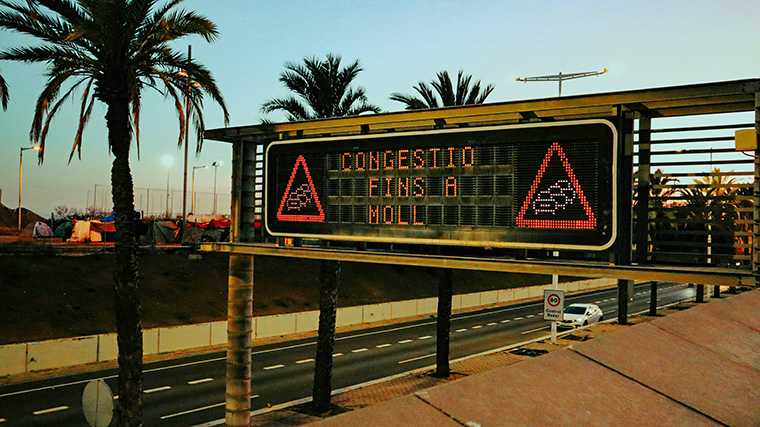
If you’re stuck in a traffic jam or have to wait for more than 2 minutes, you must turn off the engine. For example, at a railroad crossing, in front of an open bridge, or if you’re waiting at a store for your travel companion to return. If you don’t turn off the engine, you could be fined €80.
9. Both Hands on the Wheel
When driving a (rental) car in Spain, you’re not allowed to hold anything in your hands: no drink can, no snack, no sandwich. This stems from a rule that’s strictly enforced: you must always keep both hands on the wheel. As the driver, you’re therefore not allowed to eat, drink, or smoke. Failure to comply can result in a fine of €80.
10. Passing Cyclists
Spain is a popular cycling destination, so you’ll encounter (groups of) cyclists everywhere. When passing cyclists outside built-up areas, you must maintain a minimum distance of 1.5 meters in your rental car. You must also drive 20 kilometers per hour slower than the posted speed limit. Where there is more than one lane in the same direction, you must change lanes completely when passing cyclists.
The same rules apply when passing stationary vehicles, and the fine for noncompliance is €200.
Other things to keep in mind in Spain
Intersections
If yellow squares are painted at an intersection, you may only enter the intersection if you can cross it without stopping. In other words: stopping on these yellow squares is prohibited.
Spare Bulbs
It is not legally required to carry spare bulbs in your vehicle, but it is certainly handy. When picking up your rental car, ask if a set of spare bulbs is included.
Footwear
As the driver, do not drive to the beach barefoot or wearing flip-flops. While this is not officially prohibited in Spain, if you cause an accident while not wearing closed-toe shoes, there is a high chance that the damage will not be covered. You may also be fined €200.
Toll Roads in Spain
Because toll collection has been phased out on a large scale in recent years, you no longer have to pay on the vast majority of Spanish highways. There are two different types of highways in Spain: you pay a toll on AP roads (autopista), while A roads (autovía) are free. There are also other roads where tolls are charged, such as some R roads (radial roads) leading out of Madrid. You’ll also encounter toll roads in northwestern Spain, along the Mediterranean coast between Alicante and Vera (AP-7), and in Andalusia (AP-7 and AP-46).
Rental cars in Spain are generally not equipped with an electronic toll device (Via-T). You can pay tolls in cash or with a credit or debit card. Alternatively, you can purchase a toll badge in advance that works in four European countries (valid in Portugal, France, and Italy, in addition to Spain). The toll is automatically deducted from your bank account.
A free autovía usually runs parallel to the toll road, so if you’d rather not pay, you can choose that route, although these roads are busier and less direct.
Environmental Zones (ZBE)
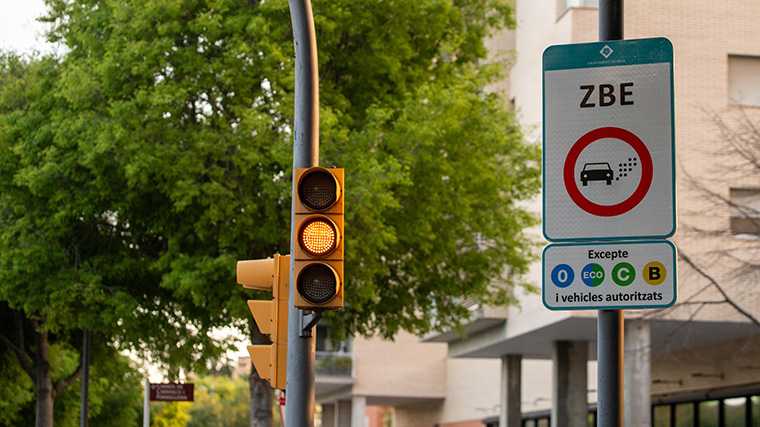
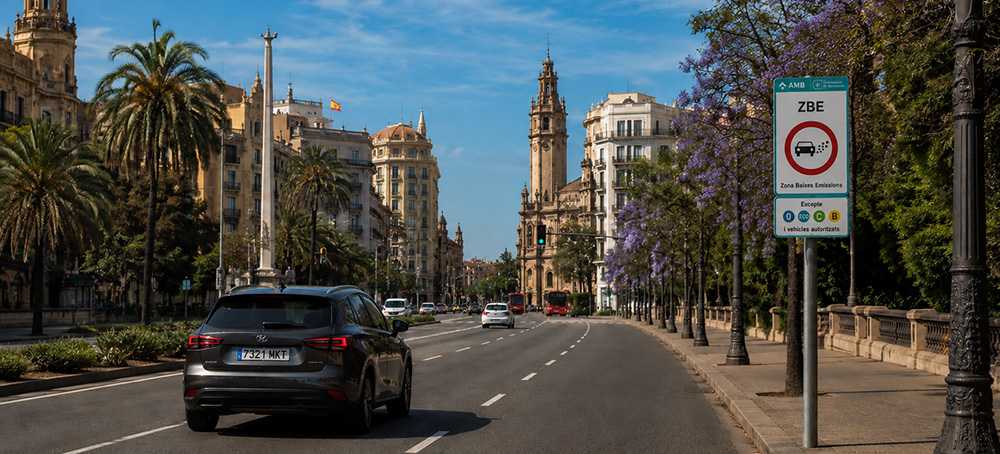
Several cities in Europe have established zones where you may only drive if your car has an emissions sticker. Spain is no exception: the country requires every city with more than 50,000 residents to establish a low-emission zone, known in Spanish as a Zona de Bajas Emisiones (ZBE). By early 2026, 56 cities had activated such a low-emission zone. In Madrid, this covers the entire area within the M30 ring road; Barcelona’s zone (ZBE Rondes) is even larger. In cities such as Seville, Málaga, Córdoba, Valencia, and Palma de Mallorca, the historic center is a ZBE.
Only cars with a special, colored sticker are allowed to drive in the low-emission zone. There are four categories: 0 (blue) for electric cars, ECO (blue-green) which mainly includes hybrid cars, C (green) for cars with an internal combustion engine that meets the latest EURO emission standards, and B (yellow) for cars that meet previous emission standards. The latter category includes cars registered in 2001 or later (gasoline) or 2006 or later (diesel).
You don’t need to worry (yet) if you’re driving a rental car into the center of a Spanish city. Not even when stricter rules take effect in 2027, when some cities will ban Category B vehicles. Cars rented through EasyTerra are generally not old and meet the latest emissions standards. To be sure, check which environmental sticker the rental car has.
The rules are still relatively lenient, but that will change. The number of cities with an emissions zone will also grow significantly. You can find up-to-date information on this interactive map.
Parking Zones in Spain
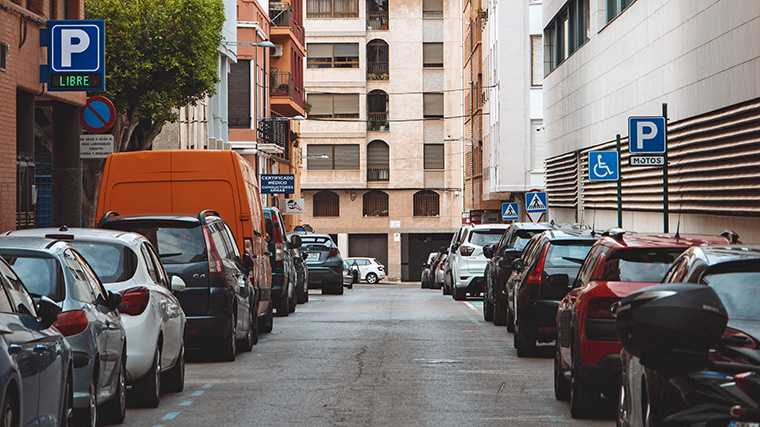
Parking in Spanish cities is a common source of unexpected fines for drivers of rental cars. Parking spaces are always marked with lines in a specific color. Here’s a breakdown:
Blue (zona azul): paid parking with a maximum time limit (usually 1 to 2 hours). This zone is also known as Zona ORA; in Madrid, it’s called Zona SER. You pay at a parking meter or via a parking app.
Red (zona roja): also paid parking, and you’ll often find these in busy or touristy neighborhoods. Be sure to read the rules on the signs carefully, especially the maximum parking duration.
Green (zona verde): reserved for residents with a permit. If you park in a green zone as a tourist, you run a high risk of receiving a hefty fine, having a wheel clamp applied, or having your rental car towed.
White (zona blanca): free parking, but you’ll hardly ever find these zones at popular destinations.
Yellow lines along the curb—whether solid or zigzag—always indicate a no-parking zone, even if you sometimes see cars parked there.
Many Spanish cities have underground parking garages, which are often a better option than street parking: you don’t have to keep track of the time, and your rental car is safer there.
Paying Fines: How It Works with a Rental Car
If you receive a traffic ticket while driving a rental car, the ticket is initially sent to the rental company, since it is the owner of the car. Based on the reservation records, the rental company knows who was behind the wheel and forwards the ticket, plus an administrative fee (€25–€50). These fees are often deducted from your security deposit or billed to you later, and apply per violation: so multiple fines mean multiple administrative fees.
Getting a fine is painful, but Spain does offer some relief—at least if you pay quickly and it’s not a serious offense. If you’re pulled over and pay the amount immediately, you’ll receive a 50% discount. That discount also applies if you pay a fine within 20 days via the official DGT portal, at any Spanish post office (Correos), or at a participating CaixaBank branch. Be on the lookout for fraud: the Spanish traffic authority does not send payment links via email or text message, so ignore such messages and use only the official channels.
Do you believe a fine is unjustified? If so, you can file an appeal within 20 days with the authority that issued the fine—the DGT, a regional agency such as Trànsit in Catalonia, or a municipality. It is not possible to file an appeal through the car rental company.
Spanish Islands: What’s Different?
On all Spanish islands (Mallorca, Menorca, Ibiza, Tenerife, Gran Canaria, Lanzarote, Fuerteventura), you drive on the right, just like on the Spanish mainland. However, there are a few island-specific points to note:
Canary Islands: The inland road network is of a lower standard, and gas stations are scarce in areas such as Anaga (Tenerife) and Timanfaya (Lanzarote). Therefore, always fill up when your fuel level drops below 50% before driving inland. Get inspired and read about the 15 highlights of Tenerife.
Mallorca and Menorca: The coastal roads are narrow, especially in the Serra de Tramuntana. If you drive early in the morning, you’ll encounter less traffic.
Ibiza: The caminos (country roads) leading to the coves are narrower than average. A mini or compact car is recommended here, especially if you’re visiting the 12 highlights of Ibiza outside the party scene.
Low-Emission Zones (LEZs): Contrary to popular belief, the Balearic Islands also have low-emission zones, known as Zona de Bajas Emisiones(Palma de Mallorca, Sóller). The same applies to the Canary Islands, with LEZs in Las Palmas de Gran Canaria and Santa Cruz de Tenerife. The number of LEZs is set to increase in the coming years.
Frequently Asked Questions About Driving in Spain
Can I drive in Spain with a Dutch driver’s license?
Yes, you can drive throughout Spain with your Dutch driver’s license, including the Canary Islands and the Balearic Islands. If you have the EU version (the plastic card), you don’t need to bring an international driver’s license. Important: always carry your original driver’s license with you. Unfortunately, copies or photos on your phone are not accepted.
How much can I drink before driving in Spain?
You might think, “Just a quick beer…” but Spain enforces this strictly. The limit is 0.5 per mille for drivers who have held a license for more than two years, and 0.3 per mille for new drivers (those who have held a license for less than two years). Fines can quickly range from €500 to €1,000, and if you’re significantly over the limit, your rental car will be impounded. Our advice? Don’t drink anything before getting behind the wheel. Just don’t take the risk.
What safety equipment is required?
Safety vests for all passengers and a V16 hazard light are required by law in every car in Spain. Rental cars usually have them, but check just to be sure before you leave. If you break down on the side of the road: put on the safety vest before getting out of the car!
What are the speed limits in Spain?
On many residential streets, the speed limit is 30 km/h (20 km/h in residential areas); on urban roads, it’s 50 km/h. Outside the city, you may drive 90 km/h on single-lane roads, 100 km/h on roads with multiple lanes in the same direction, and up to 120 km/h on highways. Be careful: speed cameras are everywhere. Fines range from €100 to €600.
Do I need a credit card to pick up the rental car?
Yes, you’ll need a credit card in the name of the primary driver to pick up the car. Debit or prepaid cards are not accepted. A security deposit (between €700 and €2,500) will be held on your account, which will be released once you return the rental car undamaged.
Can I cancel my rental car for Spain for free?
Yes, with EasyTerra , you can easily cancel for free up to 48 hours before the start of your rental period. No complicated filters or extra fees—that’s simply the standard policy. If you book a rental car within those 48 hours, free cancellation is usually no longer possible.
Rent a Car in Spain
Spain is one of the most rewarding countries in Europe to explore by rental car. The roads are of high quality, the signage is clear, and the distances between attractions are easily covered by car. A little preparation goes a long way. With this information in hand, you’ll be well-prepared to drive through Spain worry-free—whether along the coastal roads of the Costa Brava, through the mountain passes of Andalusia, or on the Balearic and Canary Islands.
Tip: For a completely worry-free driving experience in Spain, choose a rental car with EasyTerra’s Worry-Free label. That way, your deductible is covered in case of any damage!
Want to rent a car in Spain during the summer months? Be sure to read our tips on how to get the best deal during peak season first.
Find more inspiration for traveling by rental car in Spain in our blogs:
10 Day Trips from Málaga
18 top destinations around Girona
6 unique attractions on Ibiza
Discover beautiful Mallorca with a rental car
Fuerteventura is more than just sandy beaches
=========================================================
Please note: the fine amounts listed above are approximate.
Sources:

Where would you like to rent a car?
- 24000+ pick-up locations
- Free cancellation
- Independent comparator

Useful tips for a well-prepared trip
Which insurance should I choose, and what's the deal with the deposit? Read our articles with useful information and tips to ensure you choose the right rental car for you.


