- Popular countries
- Popular regions
- Popular cities
- Popular airports
- Car Rental Italy
- Car Rental Spain
- Car Rental United States
- Car Rental Portugal
- Car Rental South Africa
- Car Rental France
- Car Rental Netherlands
- Car Rental Greece
- Car Rental Germany
- Car Rental United Kingdom
- Car Rental Belgium
- Car Rental Croatia
- Car Rental Switzerland
- Car Rental Austria
- Car Rental Denmark
- Car Rental Norway
- Car Rental Australia
- Car Rental Ireland
- Car Rental Cyprus
- Car Rental Canada
- Car Rental Florida
- Car Rental Sicily
- Car Rental California
- Car Rental England
- Car Rental Sardinia
- Car Rental Mallorca
- Car Rental Ibiza
- Car Rental Crete
- Car Rental Tenerife
- Car Rental Rhodes
- Car Rental Madeira
- Car Rental Corsica
- Car Rental Gran Canaria
- Car Rental Malta
- Car Rental Scotland
- Car Rental Azores
- Car Rental Fuerteventura
- Car Rental Lanzarote
- Car Rental Corfu
- Car Rental Zakynthos
- Car Rental Amsterdam
- Car Rental Milan
- Car Rental Miami
- Car Rental Lisbon
- Car Rental Malaga
- Car Rental Porto
- Car Rental Rome
- Car Rental Cape Town
- Car Rental Barcelona
- Car Rental Faro
- Car Rental Alicante
- Car Rental Nice
- Car Rental Bari
- Car Rental Naples
- Car Rental Johannesburg
- Car Rental Brussels
- Car Rental Bergamo
- Car Rental Orlando
- Car Rental Palma de Mallorca
- Car Rental Vienna
- Car Rental Amsterdam Schiphol Airport
- Car Rental Miami International Airport
- Car Rental Lisbon Airport
- Car Rental Malaga Airport
- Car Rental Porto Airport
- Car Rental Milan Malpensa Airport
- Car Rental Rome Fiumicino Airport
- Car Rental Faro Airport
- Car Rental Alicante Airport
- Car Rental Bari Palese Airport
- Car Rental Nice Airport
- Car Rental Barcelona Airport
- Car Rental Cape Town Airport - International Terminal
- Car Rental Bergamo Airport
- Car Rental Orlando International Airport
- Car Rental Mallorca Airport
- Car Rental Catania Airport
- Car Rental Johannesburg International Airport
- Car Rental Ibiza Airport
- Car Rental Athens Airport

16 Tips for a Road Trip Through the Scottish Highlands
Glasgow is the perfect place to start when renting a car
Scotland is a destination that’s on many people’s bucket list. You have to see the almost heartbreakingly beautiful Scottish Highlands at least once in your life, right? Plus the many castles, quaint towns, vast lakes, and the occasional sip of local whiskey. Many people choose Edinburgh as the starting point for a road trip in a rental car, not least because Scotland’s largest airport is located there. But did you know that Glasgow Airport also has excellent connections? And Glasgow is definitely a more convenient starting point if you mainly want to explore Scotland’s rugged western coasts.
1. Glasgow
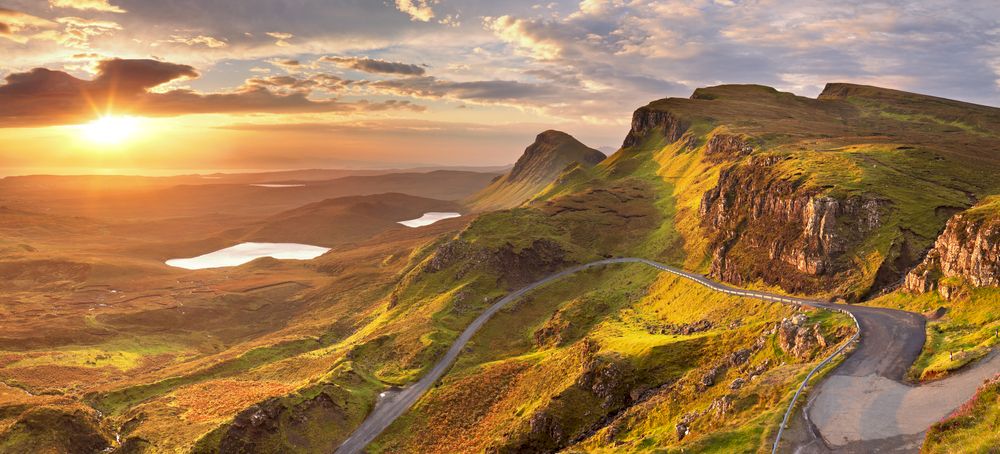
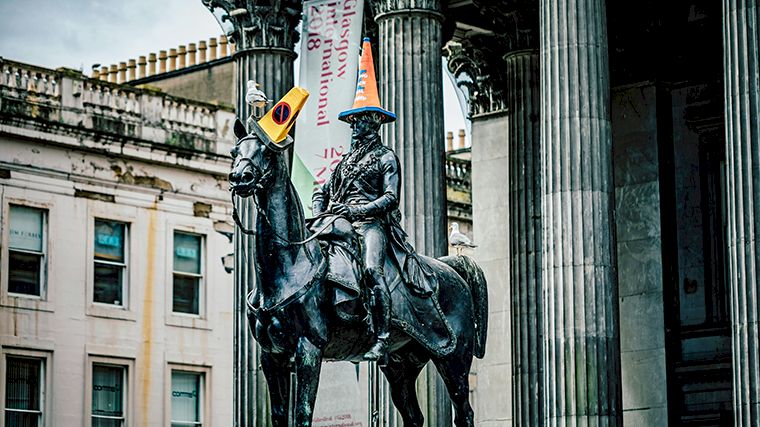
Edinburgh may be known as a city of art and culture, but don’t overlook Glasgow. The city has successfully shed the gray veil that hung over it until the 1990s. Glasgow is now a beautifully revitalized city, where you’ll find stunning architecture, great museums, and live music of every genre to enjoy. It’s a vibrant city that deserves to be explored over several days. And to get a taste of the local humor, which is most clearly evident at the statue of the Duke of Wellington in front of the Gallery of Modern Art. For decades, anonymous residents have been placing a traffic cone on his head, and when the city council wanted to raise the pedestal to prevent this, the outcry was so loud that they decided against it. Now, the Duke —complete with cone—features on the city’s promotional materials!
The Riverside Museum is a bit cluttered, but then again, it has a massive collection of vintage vehicles: bicycles, mopeds, motorcycles, classic cars, trains, trams, and even a steam locomotive. The Kelvingrove Art Gallery & Museum not only has a beautiful collection but is also housed in a stunning building, both inside and out. Many of Glasgow’s once-drab walls have been brightened up with murals, and there’s even a real Mural Trail.
2. Loch Lomond & the Trossachs
Can a busy highway also be very beautiful? You bet! The prime example in Scotland is the A82. It’s the only connection between Glasgow and Fort William (and therefore busy), but it winds through incredibly beautiful landscapes. This begins just north of Glasgow, where the road runs alongside Loch Lomond. The National Park surrounding it encompasses much more than just that long, narrow lake: no fewer than 21 mountain peaks, 22 lakes or ponds, and as many as 50 rivers or streams.
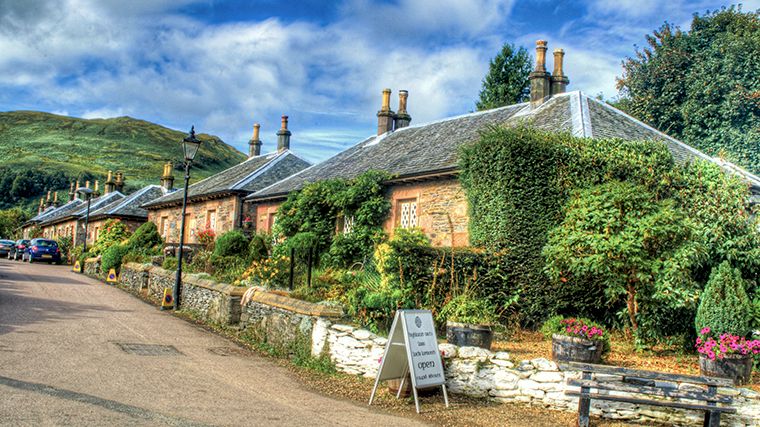
To really enjoy this area, you should actually drive your rental car to the east side of the lake. There, you can follow a hiking trail to Mount Ben Lomond (974 m). But even if you stay on the west side, you can still enjoy beautiful views. For example, by walking from the charming village of Luss to Beinn Dubh (657 m). If you’re traveling with children, be sure to follow the Faerie Trail near Luss. Your imagination will run wild as you walk past the fairy cottages and the re-education center for mischievous trolls. You can take boat tours on the lake year-round, and in the summer, you can go kayaking, canoeing, or paddleboarding on your own. There’s a huge variety of wildlife to look out for, including red squirrels, golden eagles, ospreys, and otters.
3. Rest & Be Thankful
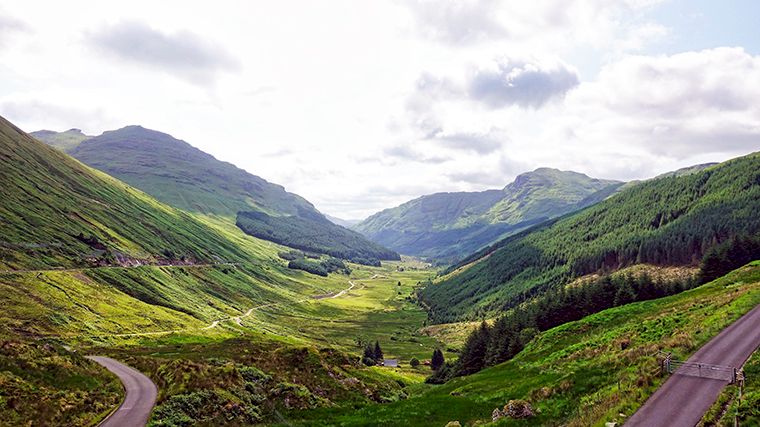
Scotland is full of beautiful viewpoints, and while you can’t visit them all, you’ll surely agree that you can’t pass up a view called “Rest & Be Thankful.” To get there, turn off the main route in Tarbet and head west on the A83. Shortly after crossing the Honeymoon Bridge over the River Croe, that road runs almost parallel to the old military road, which lies slightly lower. That road climbs steeply from Glen Croe, and the soldiers who built it were glad when they finally reached the highest point. It’s still a great spot for a stop, and you’ll enjoy a beautiful view of the valley and that old military road.
Please note: The A83 is often plagued by landslides, and in such cases, the road is, of course, closed. It’s also closed if there’s a high risk of soil being washed away. Check Traffic Scotland for the current situation. That’s also a very handy website for information about other roads in Scotland.
4. Falls of Falloch
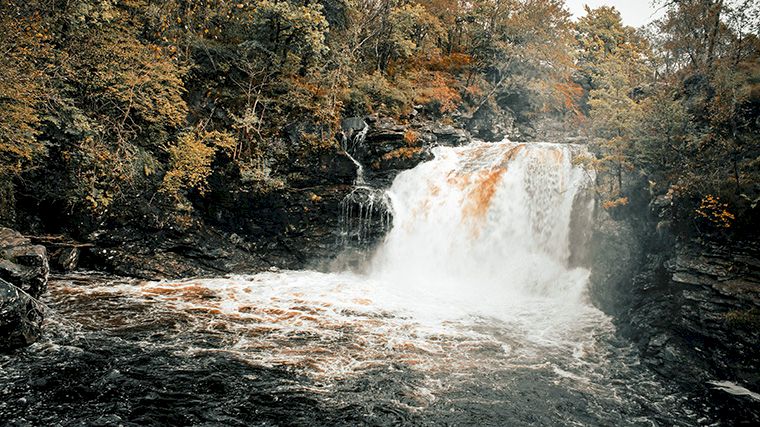
The further north you drive on the A82, the more mountainous the landscape becomes. Just past the hamlet of Inverarnan, you’ll see a turnoff from the A82 leading to the Falls of Falloch. From the parking lot, it’s a five-minute walk to the waterfall, which isn’t very tall but is set in picturesque surroundings. There’s a viewing platform that juts out over the water; it’s called Woven Sound because the sound of the thundering water reaches you through the canopy of interwoven steel rods. At the end of the platform, you’ll have an unobstructed view of the waterfall.
During the summer months, the parking lot can fill up quickly. In that case, you can turn your rental car around and look for a path about one kilometer back. That path is blocked by a gate, but you’re allowed to go through it as long as you close the gate behind you. You’ll then reach the West Highland Way, a long-distance trail that runs along the rapids of the Falloch River here, before you reach the waterfall.
5. Bridge of Orchy / Loch Tulla
From the town of Crianlarich, it’s an eighteen-kilometer drive to Bridge of Orchy, named—as the name suggests—after an old little bridge over the Orchy River. This is a perfect spot for lunch, as there are picnic benches along the water near the bridge. This spot has been a resting place since the eighteenth century—back then for soldiers, since the bridge was part of a military road. Rafting adventures begin from that parking lot, as in winter or after heavy rainfall, the Orchy becomes a fast-flowing river. Rafting here is for advanced rafters only.
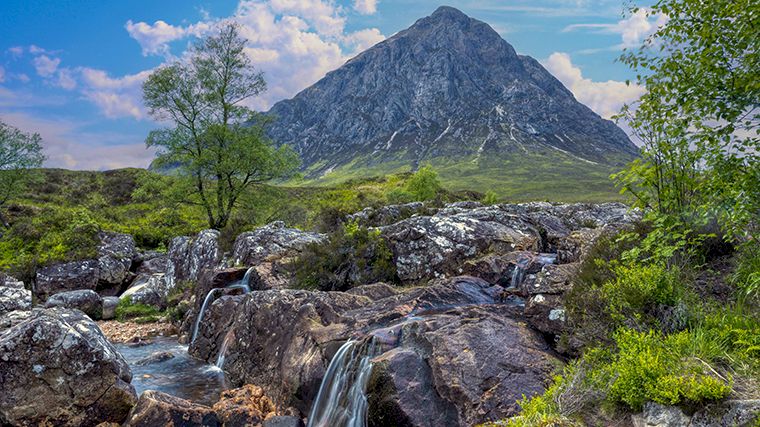
You’re allowed to spend the night in a campervan in the parking lot, but there’s also a very narrow road leading to a hotel on Loch Tulla. Unfortunately, there’s nowhere to park along that road or at the hotel (since parking is reserved for guests), but at the end of the road, you can park your rental car in a lot just before Victoria Bridge.
Incidentally, there’s also a beautiful viewpoint along the A82 overlooking Loch Tulla and the surrounding mountains, just over seven kilometers past Bridge of Orchy. Further along, one magnificent viewpoint follows another: first two overlooking Lochan na h-Achlaise, then the view over Loch Ba, and next over the marshy heathland of Rannoch Moor. A little further on, there’s a turnoff to the Glencoe Mountain Resort. In winter, you can ski and snowboard there; in summer, mountain bike. A chairlift takes you nearly seven hundred meters higher to a mountain plateau. Immediately upon arrival, you’ll have a beautiful view of the summit of Creag Dhubb, and after a walk of just over one kilometer, you’ll look out over Glen Etive.
6. Glencoe
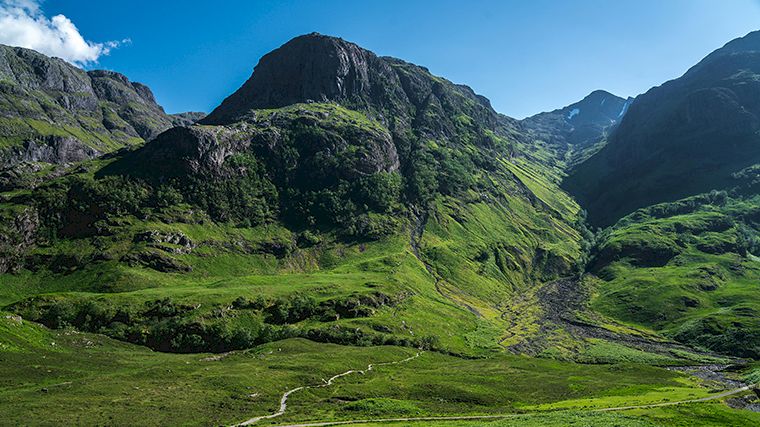
The route toward Glencoe winds through increasingly spectacular scenery. It’s as if, with every kilometer, you’re turning a page in a beautiful photo book filled with breathtaking natural beauty. There are several places where you can park your car to take in the view of waterfalls or at the start of a hiking trail. Just after you cross the little river Etive, you can turn left for a picturesque drive through the river’s valley. If you’ve seen the James Bond movie *Skyfall*, you’ll recognize this area.
Further along the A82, there’s a parking lot offering a view of the Three Sisters, three tall peaks in the Bidean nam Bian mountain range, which includes several other peaks. Do yourself a favor and walk down from the (sometimes crowded) parking lot to the river, where it’s much quieter and you can enjoy nature in peace. You can take some wonderful hikes here, but be sure to first check out the options at the National Trust Visitor Center in Glencoe. Short hikes start from this visitor center, but you can also get information there about other routes through the mountains, such as through the Hidden Valley. There’s a large model showing which routes lead where. You can also explore a replica of a house where peat cutters used to live.
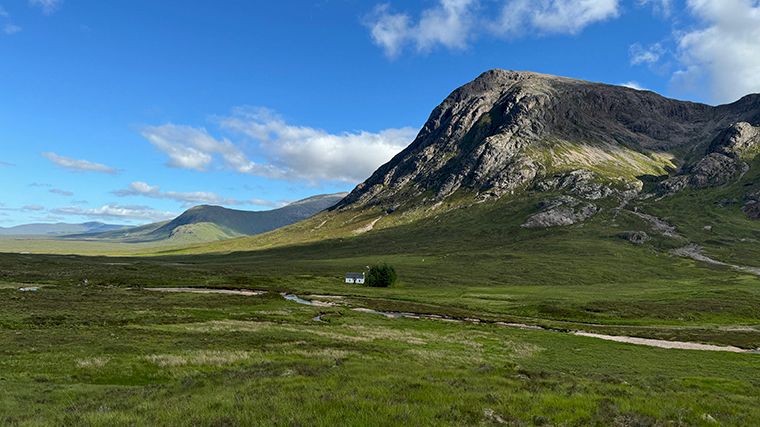
Mount Pap of Glencoe, with its steep and distinctive conical summit, is a fairly challenging climb. The mountain isn’t very high (742m), but the climb follows a rugged trail and is marshy in places. The final stretch is downright steep, and you’ll have to scramble at times. Be sure to wear good hiking boots if you plan to hike to the summit, where you’ll be rewarded with a sensational view.
7. Fort William
As you drive north across the Ballachulish Bridge, you’ll see Loch Leven on your right—a side arm of Loch Linnhe, which lies to your left and connects to the open sea. Not in a hurry? Then take the alternative route along the southern shore of Loch Leven to Kinlochmore and back via the northern shore. There are several picnic spots along this road, and in Kinlochmore you can hike to the Grey Mares Tail waterfall .
Just past the bridge, the A82 runs right alongside Loch Linnhe toward Fort William. While the A82 has been a stunning road so far, the view here is even more beautiful, if that’s possible. This is especially true if you drive past this loch in the early morning, when the rising sun beautifully illuminates the mountains across the water.
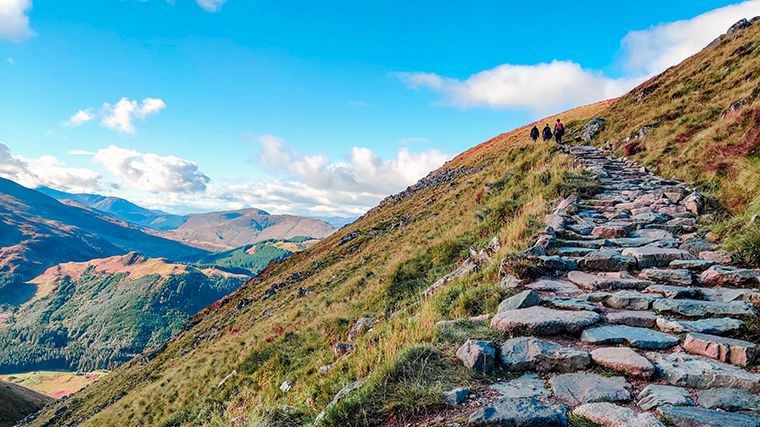
Fort William lies in the shadow of Great Britain’s highest mountain, the mighty Ben Nevis (1,344 m). You can climb the mountain, but don’t take it lightly. The most popular route starts at the visitor center in Glen Nevis: even in good weather, this is a challenging hike, and in winter, it places even greater demands on your mountaineering skills. An easier option is to view the waterfalls and rapids as you drive further south in your rental car: Lower Falls, Paddy’s Bridge, Water of Nevis Point, and Steall Waterfall. You can also view Scotland’s highest mountain from a distance, from the Nevis Range Resort, just northeast of Fort William. In winter, it’s a ski resort, but you can take the cable car up year-round.
8. From Fort William to the Isle of Skye
The Isle of Skye is a rugged and mountainous island with spectacular scenery and rock formations you won’t find anywhere else. A visit to Scotland isn’t really complete without stopping by this enchanting island. There are countless beautiful places to visit, and if you want to explore Skye thoroughly, give yourself at least three days here. If you’re traveling to Skye during the summer months, be sure to book your accommodations in advance, as the island gets very crowded then. To avoid the crowds, it’s better to go in the spring or fall. Or in the winter, but keep in mind that many accommodations and restaurants on Skye are closed during that time.
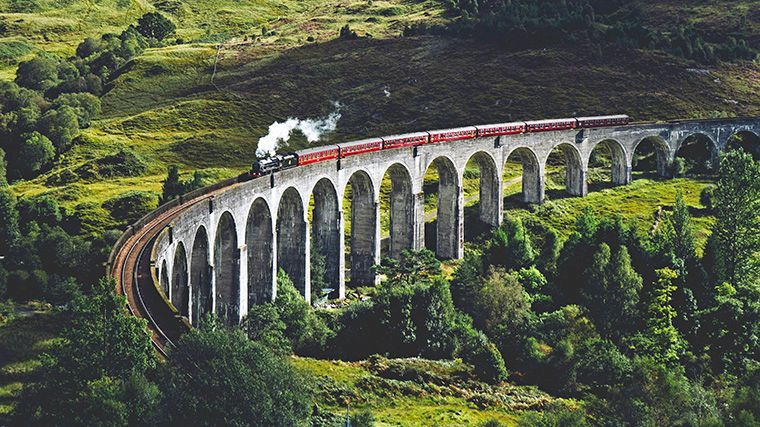
From Fort William, there are two ways to drive to Skye: via the A830 (Road to the Isles) to Mallaig, and then take the ferry across to Armadale. If you’re planning this, be sure to check with the local rental company when picking up your rental car to see if they allow you to take the car on a ferry! This is a stunningly beautiful route that passes, among other sights, the Glenfinnan Viaduct —the “Harry Potter viaduct”—where the steam train Jacobite runs across it. You might encounter that same steam train further along, where the A830 passes under the Loch nan Uamh Viaduct.
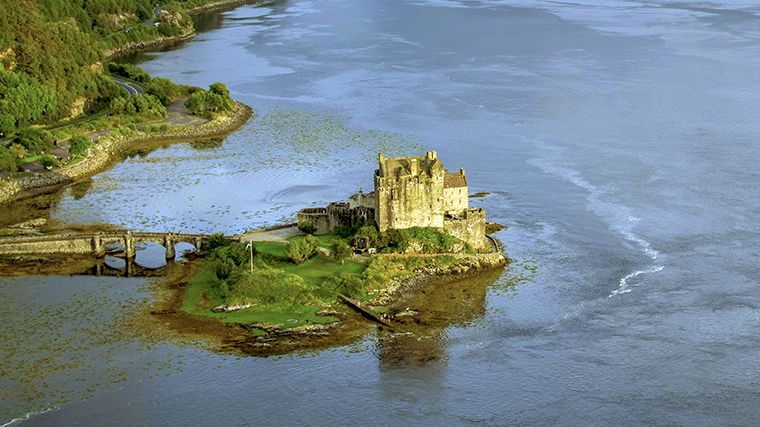
Thanks to the Skye Bridge, the island is also accessible by road. From Fort William, you first drive north on the A82 and then, at Invergarry, follow the A87 west. This road passes no fewer than four lochs and offers several beautiful viewpoints along the way. Near Dornie, on a small island, stands the 13th-century Eilean Donan Castle, which has been beautifully restored. Many visitors are rather disappointed by what’s inside, so you might want to just take a photo of the exterior. You do have to pay for parking, but just past a bridge a little further on, there’s a free parking lot, and from that bridge you might actually have an even better view of the castle.
Just over 25 kilometers (16 miles) past the bridge, you’ll reach the Eas a’ Bhradain waterfall. You can park your rental car either before or after the waterfall and then walk along a path beside the road to the lookout point. If you’re wearing sturdy shoes, you can hike down to the water’s edge, but the waterfall already looks spectacular from the road, especially in winter and early spring or after heavy rainfall.
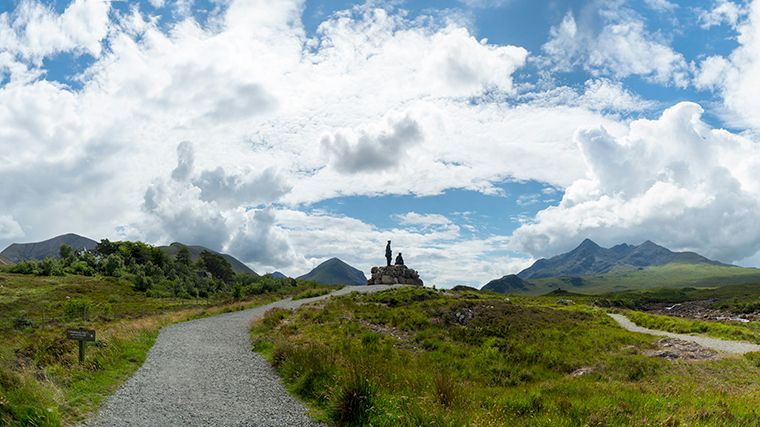
A little further on, the A87 crosses the small Sligachan River, and you’ll see an old little bridge on your right. You can stop here for a moment—not only to admire the bridge, but especially because this is a great spot to see how the two mountain ranges on either side of Glen Sligachan dominate the island. On one side are the rounded peaks of the Red Cuillin; on the other, the more ominous Black Cuillin, jagged like a row of broken teeth. The Black Cuillin is a challenging mountain range, featuring, among other peaks, the “impregnable pinnacle” In Pinn, suitable only for experienced mountaineers. Those who prefer a more leisurely pace can hike in the hills of the Red Cuillin. From Sligachan, it’s another 16 kilometers (10 miles) drive to Skye’s main town, Portree.
9. The Storr
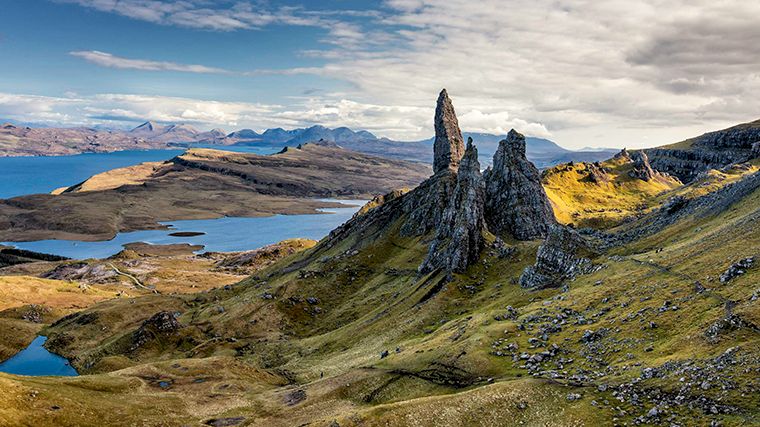
When you stand at Bride’s Veil waterfall, which is located right next to the road north of Portree, you can already see the outline of the jagged rock formation known as The Storr. The steep rock face on one side contrasts with the gently sloping, green grassy slope on the other. That rock face was formed by a massive landslide. In the area in front of the steep cliff face— the Sanctuary —there are rock pillars with whimsical shapes. The best known is the Old Man of Storr, so named because, with a little imagination, you can make out the silhouette of an old man.
Along the A855, there is ample parking at the start of the trail to The Storr. The trail first leads to a lookout point and then loops around and over the rocks. That section can be very slippery, especially right after rain.
10. Lealt Falls & Brother’s Point
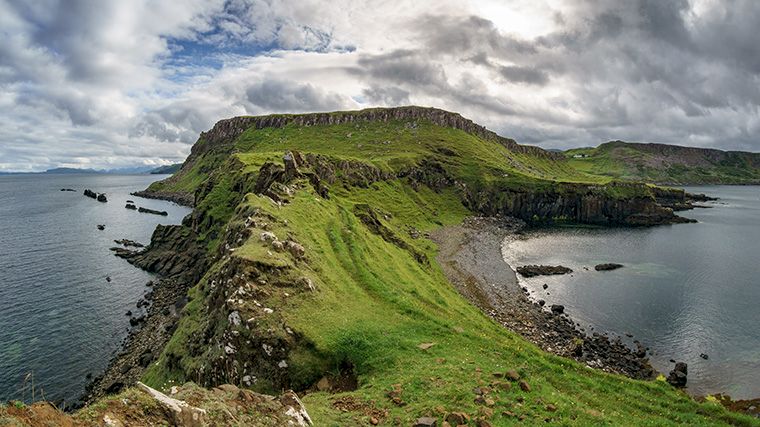
Eight kilometers further on, you’ll come to a parking lot where you can view Lealt Falls. Of course, the falls are at their most beautiful after heavy rainfall. A viewing platform hangs above the upper falls, but it’s the thundering lower falls that are truly worth seeing. You can reach them by following a trail past a second parking lot toward the coast (which also offers a beautiful view!) and then zigzagging downhill. Once you’re almost at sea level, turn right and walk along the Lealt River to the base of the falls. Not many people do this, so with a little luck, you’ll have those lower falls all to yourself.
Once you’re back at the parking lot, you can follow a trail to Brother’s Point, a headland a little further north. You’ll walk past charming cottages that are available for rent. Looking for a place to stay on Skye? But you’ll need a rental car. You can drive to Brother’s Point —there’s a small parking lot along the road. From there, you’ll need to walk back a short distance to follow the path to the coast. With a bit of effort, you can find fossilized dinosaur footprints there at low tide.
11. Kilt Rock & Mealt Fall
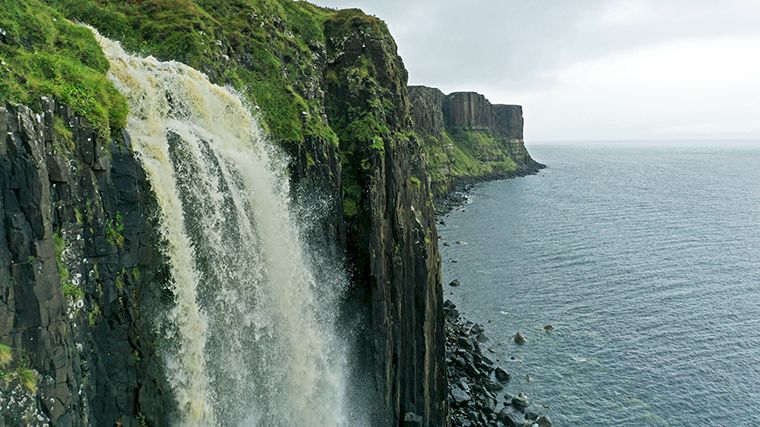
Just three kilometers further north, there is a turnoff to a (paid) parking lot where you can view Mealt Fall. This waterfall flows from a small lake and then plunges into the sea along a steep rock face. If you look north from the lookout point, you’ll see a unique coastline made up of basalt columns. Because of the columns’ striped appearance, the rock resembles a Scottish kilt—hence the name Kilt Rock.
12. Quiraing
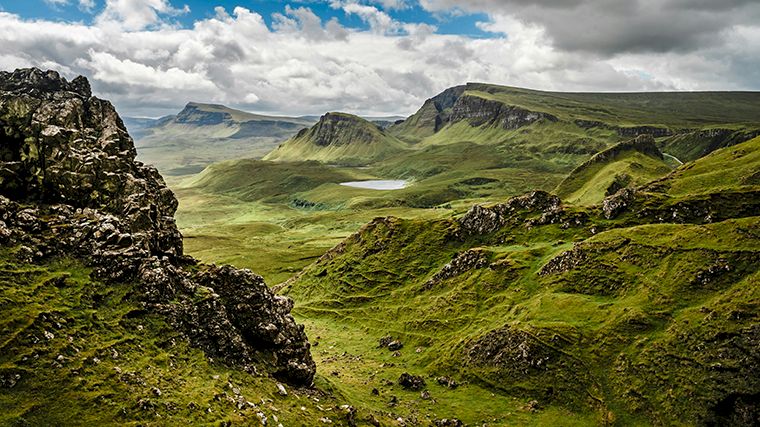
Skye is best known for the strange and magical landscape of the Quiraing. You’ve already had a taste of it at The Storr, but here you can see it on a much larger scale. Just like there, it was formed by a thick layer of flood basalt that spread across the land, causing landslides. The result is a plain surrounded by steep rock walls, but within that plain there are also higher plateaus, such as The Table. You’ll also see jagged rock formations with nicknames like The Needle and The Prison. It’s a landscape you could spend hours gazing at—and, of course, hiking through, including along the Quiraing Circuit Trail.
The turnoff to Quiraing is located at a bend in the A855. The road quickly narrows into a very narrow path that climbs up to a parking lot at the start of the hiking trail. Prefer to stay on the A855? Then you can drive a bit further north and park your rental car just before the village of Flodigarry. A trail leads to Loch Langaig, offering a different perspective on the intriguing landscape of the Quiraing.
13. Skye Museum of Island Life
As you’ve noticed, many attractions on Skye are not far from the A855, and that’s also true of the Museum of Island Life. It’s a small but very charming open-air museum that takes you back in time. The museum consists of a thatched tenant farmer’s cottage, a barn, a small shop, a blacksmith’s shop, a weaving workshop, and a so-called ceilidh house, where people used to gather to play music and sing. Everything is set up to reflect how people on the island lived and worked over a hundred years ago. Outside, you’ll find old farming tools and carts. You’ll also enjoy a beautiful view of the sea, with sheep and Scottish Highland cattle grazing in the foreground. The museum is open from Easter through the end of September.
14. Fairy Glen
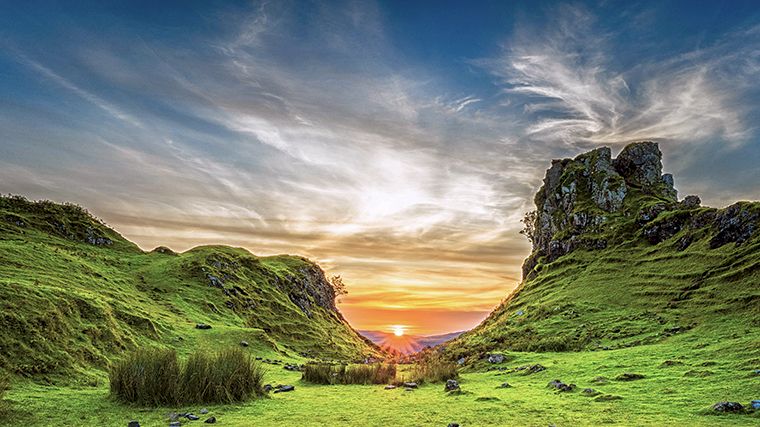
Near the village of Uig, another very narrow road (but with passing places) leads east toward Fairy Glen. Just past the hamlet of Sheader, there’s a parking lot where you can park your rental car. Near the payment machine, a trail begins that leads to the most beautiful view of this valley, which is the subject of many legends in which fairies play the leading role. In 2013, unknown individuals set up a stone circle, and after it was removed, they kept rebuilding it. The locals were driven crazy by it, so there are now signs asking people not to move the stones—because the fairies don’t like that!
15. Dunvegan Castle & Gardens
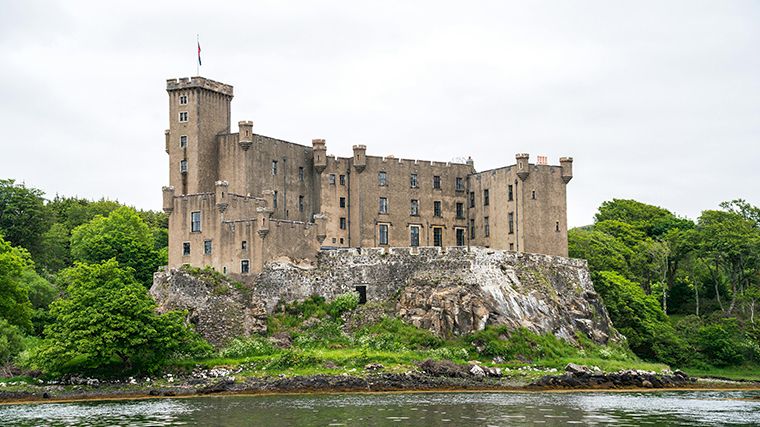
Armadale Castle is beautiful, but unless you’re taking the ferry to or from Skye, you probably won’t end up in the area. In that case, visit historic Dunvegan Castle and its stunning gardens. The castle is built on a rocky outcrop on the shores of Loch Dunvegan and is the oldest continuously inhabited castle in Scotland. After the guided tour of the castle, you’ll enjoy a beautiful view from the top of the gardens and the seal colony on a small island off the coast. Boat tours are organized to get a closer look at those seals.
16. Bealach na Bà / NC 500
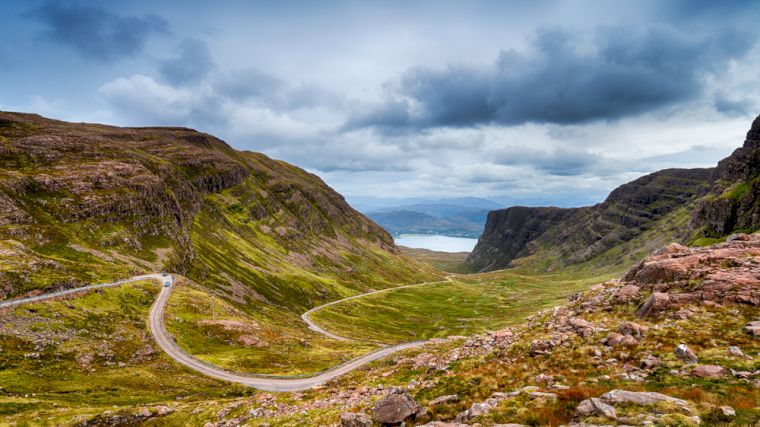
If you enjoy a challenging, winding road, don’t miss the Bealach na Bà Pass across the Applecross Peninsula on the Scottish mainland. The turnoff to this pass is three kilometers north of the village of Kishorn. Right at the start, a large sign warns you that the road is not suitable for large vehicles or learner drivers. The road quickly narrows to a single track (with passing places), and that’s when the real thrill begins. Around the highest point, you’ll navigate one sharp hairpin turn after another, enjoying a fantastic view of the cliffs with the sea visible in the distance between them. This pass is part of the North Coast 500, one of the most beautiful coastal routes in the world. As the name suggests, this 500-mile (over 800-kilometer) route runs along Scotland’s incredibly beautiful north coast. The official starting and ending points are in Inverness, but you can, of course, begin the route anywhere—such as via this mountain pass. Incidentally, closer to Glasgow, you can also follow a beautiful route that runs through the heart of Scotland and is therefore called the Heart 200. This route passes through Stirling, more than forty kilometers northeast of Glasgow.
Rent a car for a road trip through Scotland
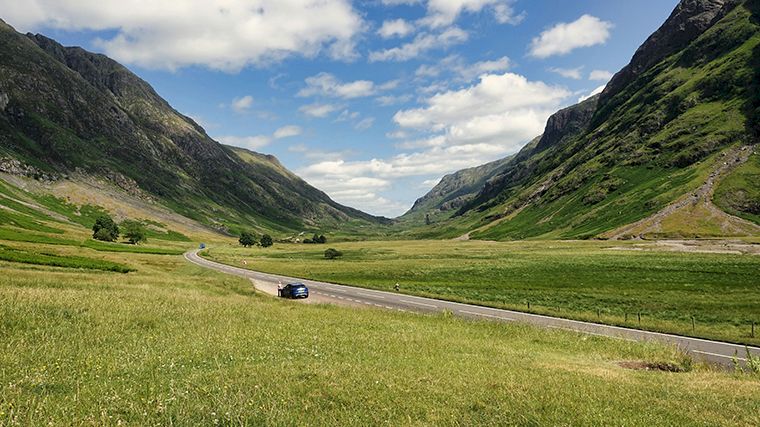
If you’re looking for an almost otherworldly, rugged landscape for your next trip, look no further than the Scottish Highlands. We hope the attractions in Scotland listed above have given you some ideas. Choose the ones that appeal to you and start making plans for your trip. Don’t forget to reserve a rental car in advance, because if you wait until the last minute, the price could end up being higher. Renting a car is ideal for a vacation in Scotland, because, as you’ve read above, the most beautiful spots are only easily accessible if you have your own transportation. And driving along the stunning Scottish roads is a fantastic experience in itself. What are you waiting for? Reserve a rental car in Scotland for an unforgettable trip!

Where would you like to rent a car?
- 24000+ pick-up locations
- Free cancellation
- Independent comparator

Useful tips for a well-prepared trip
Which insurance should I choose, and what's the deal with the deposit? Read our articles with useful information and tips to ensure you choose the right rental car for you.