- Popular countries
- Popular regions
- Popular cities
- Popular airports
- Car Rental Italy
- Car Rental Spain
- Car Rental United States
- Car Rental Portugal
- Car Rental South Africa
- Car Rental France
- Car Rental Netherlands
- Car Rental Greece
- Car Rental Germany
- Car Rental United Kingdom
- Car Rental Belgium
- Car Rental Croatia
- Car Rental Switzerland
- Car Rental Austria
- Car Rental Denmark
- Car Rental Norway
- Car Rental Australia
- Car Rental Ireland
- Car Rental Cyprus
- Car Rental Canada
- Car Rental Florida
- Car Rental Sicily
- Car Rental California
- Car Rental England
- Car Rental Sardinia
- Car Rental Mallorca
- Car Rental Ibiza
- Car Rental Crete
- Car Rental Tenerife
- Car Rental Rhodes
- Car Rental Madeira
- Car Rental Corsica
- Car Rental Gran Canaria
- Car Rental Malta
- Car Rental Scotland
- Car Rental Azores
- Car Rental Fuerteventura
- Car Rental Lanzarote
- Car Rental Corfu
- Car Rental Zakynthos
- Car Rental Amsterdam
- Car Rental Milan
- Car Rental Miami
- Car Rental Lisbon
- Car Rental Malaga
- Car Rental Porto
- Car Rental Rome
- Car Rental Cape Town
- Car Rental Barcelona
- Car Rental Faro
- Car Rental Alicante
- Car Rental Nice
- Car Rental Bari
- Car Rental Naples
- Car Rental Johannesburg
- Car Rental Brussels
- Car Rental Bergamo
- Car Rental Orlando
- Car Rental Palma de Mallorca
- Car Rental Vienna
- Car Rental Amsterdam Schiphol Airport
- Car Rental Miami International Airport
- Car Rental Lisbon Airport
- Car Rental Malaga Airport
- Car Rental Porto Airport
- Car Rental Milan Malpensa Airport
- Car Rental Rome Fiumicino Airport
- Car Rental Faro Airport
- Car Rental Alicante Airport
- Car Rental Bari Palese Airport
- Car Rental Nice Airport
- Car Rental Barcelona Airport
- Car Rental Cape Town Airport - International Terminal
- Car Rental Bergamo Airport
- Car Rental Orlando International Airport
- Car Rental Mallorca Airport
- Car Rental Catania Airport
- Car Rental Johannesburg International Airport
- Car Rental Ibiza Airport
- Car Rental Athens Airport

14 Tips for an Unforgettable Vacation in Corfu
Explore the most beautiful spots in a rental car
The island of Corfu (officially Korfoe in Dutch, but the English spelling is more common) lies off the west coast of the Greek mainland. The “Queen of the Ionian Sea” embodies the essence of both Greece and Italy, which lies just 100 kilometers away. From the 14th to the 18th century, the island was part of the powerful Republic of Venice. Later, in the 18th and 19th centuries, Corfu was alternately occupied by France and Great Britain, allowing both the French and the British to leave their mark. This makes it a unique Greek island where various cultures have left their imprint.
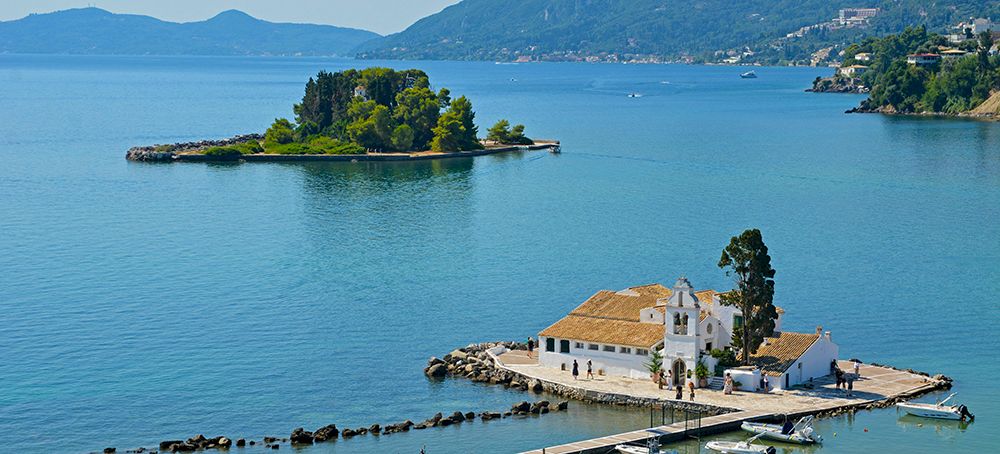
So it won’t surprise you that Corfu is an island steeped in history, with numerous sights from different eras. It’s also one of the greenest Greek islands, and you can choose from a variety of places to swim in the sea: from secluded coves with pebble beaches nestled among the rocks to long sandy beaches. The best way to really get to know Corfu is to rent a car. Many remote villages, picturesque spots, and beaches aren’t easily accessible by public transportation. You’ll be amazed at how many beautiful sights you can see when you have a car at your disposal in Corfu.
Corfu Town
You’ll likely pick up your rental car at Corfu Airport, located near the island’s charming capital. If you don’t want to just lounge on the beach, the city is a perfect base for day trips, since Kérkyra (the Greek name) is centrally located on the long, narrow island. As a result, virtually all the best spots are less than an hour’s drive from the capital in a rental car. What’s more, Corfu Town is incredibly charming, and after a day trip, it’s lovely to unwind at one of the many outdoor cafes.
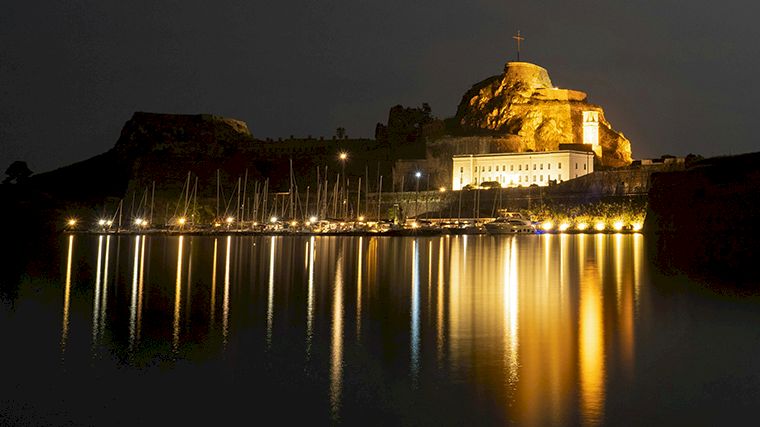
But don’t forget the sights in the old city itself. Perched high on a rock is the Venetian fortress, which managed to withstand three Ottoman attacks but was ultimately destroyed when lightning struck the gunpowder storehouse in 1718. In the nineteenth century, the British built an Anglican church there with Doric columns. Today, it’s a Greek Orthodox church. On the western side of the old town lies a more recent Venetian fortress. For a completely different perspective (and fun for kids), take a trip from here on a replica pirate ship. The tour passes, among other places, the small island of Pontikonisi, which lies directly beneath the airport’s flight path. Airplanes fly low over the area, and you can also spot them from the pedestrian bridge near the picturesque Vlachérna Monastery, south of Corfu Town. This viewpoint is especially breathtaking at sunset.
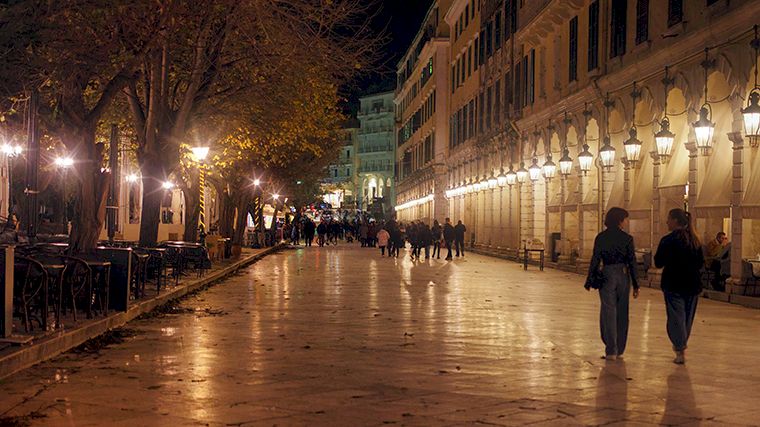
The Palace of St. Michael and St. George was also built by the British as a residence for the High Commissioner. Today, it is an interesting museum of Asian art. It’s located on the north side of the city’s main gathering place, the large Spianada Square, surrounded by cafés, outdoor dining areas, and the famous Liston colonnade. Nearby stands the Casa Parlante, a 19th-century residence where you can see how an aristocratic family lived on Corfu during that era. Just south of the capital, you can stroll through fragrant, flower-filled gardens to the former summer residence of the Greek royal family, the Villa Mon Repos. On the ground floor, you can see how the monarch lived there; on the first floor, there is an exhibition of archaeological finds. In the southern part of the park surrounding the villa, you’ll find the remains of a Greek temple.
Achilleion Palace
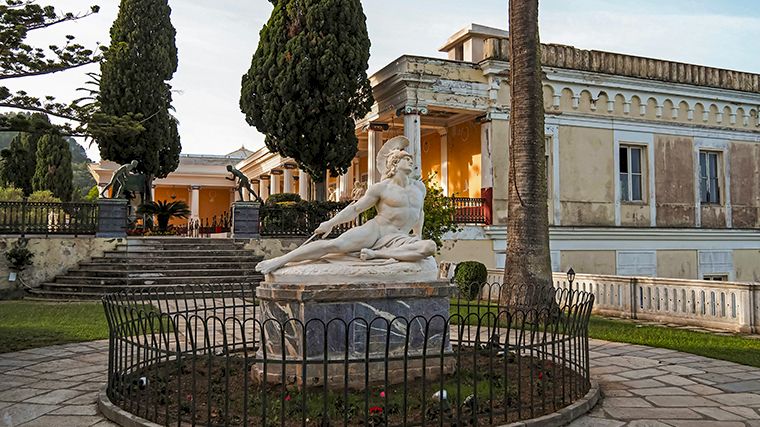
When the Austrian Empress Elizabeth, better known as Sissi, visited the Mon Repos villa, she fell in love with Corfu at first sight. She promptly had a summer residence built there and named it Achilleion, after the Greek hero Achilles. A statue of him stands on the terrace, and the palace gardens also feature many statues and structures inspired by Greek mythology, including Eros and Psyche at the entrance. Sissi was not able to enjoy it for long, however, as she was assassinated six years after the palace was completed. Her daughter sold it to German Emperor Wilhelm II, but after World War I, the Greek state became the owner.
The Achilleion is situated on a hill in the village of Gastouri, ten kilometers south of Corfu Town. The palace houses countless works of art, including paintings by Claude Monet and portrait sculptures of Empress Elisabeth. You’ll also find furniture, costumes, and personal belongings of the former residents. A highlight is the Imperial Throne, a large chair made especially for Sissi’s husband, Emperor Franz Joseph I of Austria. The throne is adorned with wood carvings and mosaics depicting scenes from Greek mythology. From the terrace, you’ll enjoy a panoramic view of Corfu Town and the Ionian Sea.
Please note: Since 2020, the palace has been undergoing renovation, and only the gardens are accessible. It is unclear when the palace will reopen to the public. Please check the Achilleion Palace website for updates.
Road Trip to Sidari / Cape Drastis
There’s no getting around it: Corfu is a tourist island, and if you want to see the less touristy side, you’ll need to rent a car and head out. On a day trip to the seaside resort of Sidari on the north coast, you’ll drive through beautiful countryside and pass through quiet mountain villages. And even in the somewhat noisy town of Sidari, you can find quiet spots—at least, if you have a rental car at your disposal.
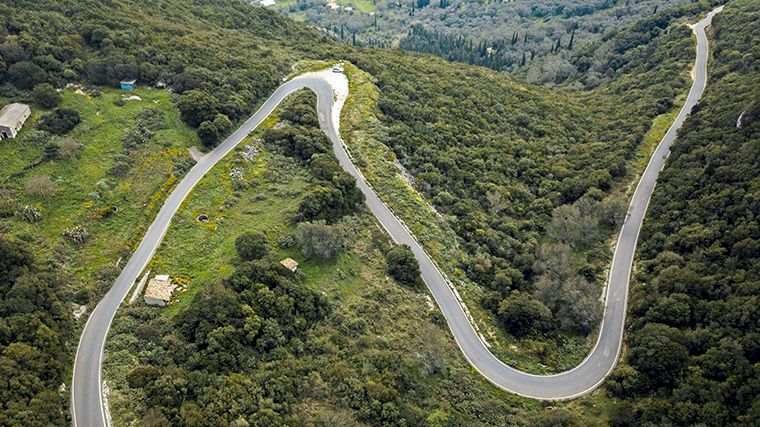
From Corfu Town, follow the signs to Palaiokastritsa and drive along the main coastal road toward Gouvia. In Gouvia, you’ll see a sign for Sidari (the main sign above the road says “Palaiokastritsa”). Continue along the main road, which veers inland from the coast. Here, the landscape becomes even more beautiful: you’ll drive through a densely forested valley. A little further on, you’ll come to a fork in the road, where the direction to Sidari (to the right) is clearly marked on signs. The road now climbs toward the Troumpeta Pass, one of the most beautiful spots on the island. It’s well worth taking a small side road here, parking your rental car, and taking a short walk to enjoy the fabulous view. Or, in the village of Troumpeta, take the right turn toward Sokraki to go a little higher. To reach Sidari, drive straight ahead; immediately after Troumpeta, the road begins to descend toward a fork. There, take the sharp right turn and continue north through very quiet mountain villages—Chorepiskopi, Valanio, and Agrafi—where life goes on at its own pace, just as it has for centuries. After the steep streets in Karousades, it’s another four kilometers to Sidari.
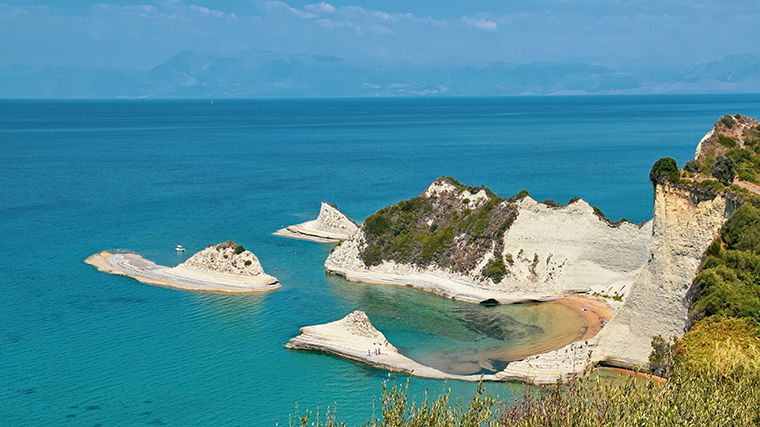
In Sidari, you’re back in the heart of Corfu’s bustling tourist scene, but it’s a wonderful spot to sit by the water and reflect on your journey through the mountain villages. Near Sidari lies Kanali tou Erota, an idyllic area with impressive rock formations and crystal-clear blue water. According to legend, taking a dip in the water here brings good luck in love. We say: it can’t hurt to try, because even without making wishes for love, it’s a great place to swim. Warning: don’t go into the water when the wind is strong and the sea is rough—it’s dangerous then!
A little further on lies Cape Drastis, the northwesternmost tip of Corfu. Here, too, you’ll find majestic, steep limestone cliffs, but it’s quieter than at the Canal d’Amour because it’s harder to reach. At the end of the paved road leading there, you won’t see much yet, but follow the sandy path on foot and you’ll be rewarded with fantastic views of the limestone cliffs. The small beach at the bottom is accessible only by boat. You can rent a small boat in Peroulades, a seaside resort that’s a bit smaller and quieter than Sidari. Peroulades also offers beautiful views of the dramatic cliff-lined coast. There’s even a small glass platform that juts out over the edge of a cliff.
Palaiokastritsa
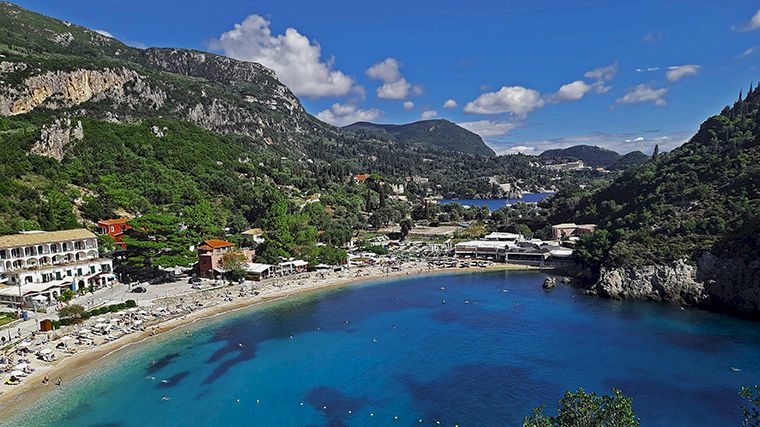
We might complain that a place is “really, really touristy,” but there’s always a reason for that. For example, because it’s incredibly beautiful. That’s certainly true of Palaiokastritsa, also known as the jewel of Corfu. The beaches here are surrounded by rugged cliffs topped with green vegetation. The busiest beach is Agios Spiridon, followed by Agios Petros on the other side of the headland that juts out into the sea here, and Ampelaki Beach next to it. These are large sandy beaches, but Palaiokastritsa’s main appeal lies in its countless coves with small beaches (often pebbly, though) and sea caves that can only be reached by boat. You can choose from various organized boat tours or rent a small boat or kayak yourself to explore the bay. You’ll find small, secluded beaches, often surrounded by rocks with fascinating patterns, such as Marmera Beach and the Blue Eye cave.
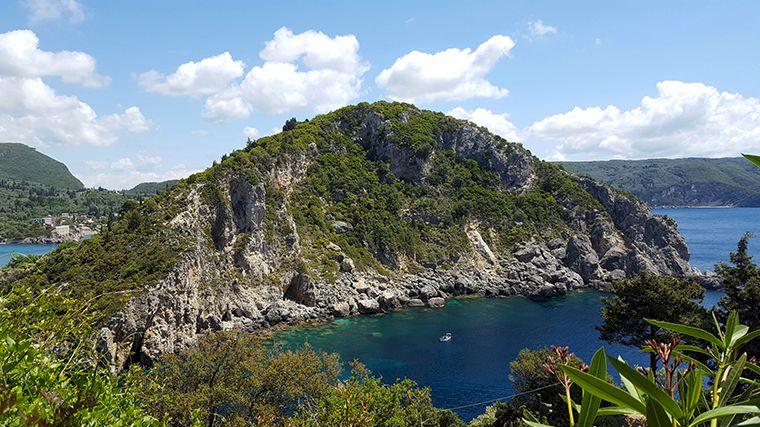
A monastery has stood on the rocky headland to the right of Agios Spiridon Beach since the thirteenth century. Nothing remains of the original structures; what you see today dates from the sixteenth century, with a few additions from the eighteenth century. The monastery is known for its serene courtyards and elegant frescoes. You can walk there from Palaiokastritsa, but you can also get there by rental car. Most people visit this rocky area for the phenomenal views. Be prepared, though, to do some serious climbing to get the best vistas.
Angelokastro
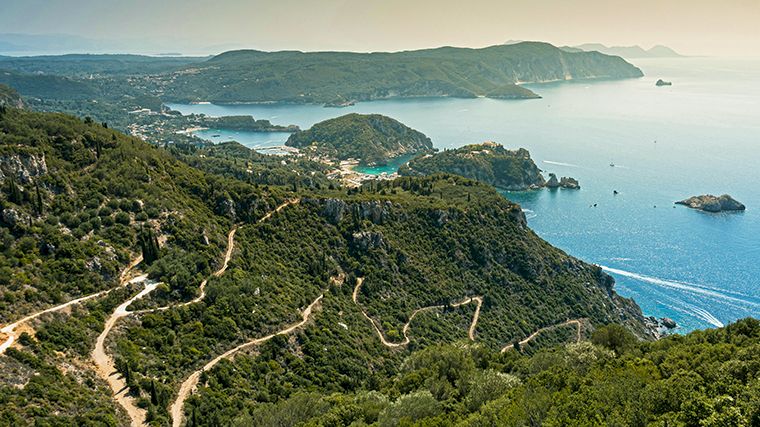
You’ll find even more history combined with beautiful views just west of Palaiokastritsa, near the village of Krini. At the highest point on Corfu’s west coast stand the ruins of Angelokastro, a castle from the Byzantine era. It was built to protect Corfu from pirate attacks. In fact, only the fortress walls remain standing; nothing is left of the buildings that once stood within them. For most visitors, then, it’s not so much the historical significance that matters, but the panoramic views. Here, too, you can drive quite far up in your rental car, but you’ll have to hike the last stretch to the top yourself. To park your car, you’ll need to arrive early, as parking spaces are limited.
If you look down from the castle, you’ll see two very inviting little beaches, Kastelli and Mikro Kastelli. These are accessible only by boat, so to visit them, you’ll have to return to Palaiokastritsa to rent a kayak or motorboat there.
Chalikounas / Lake Korission
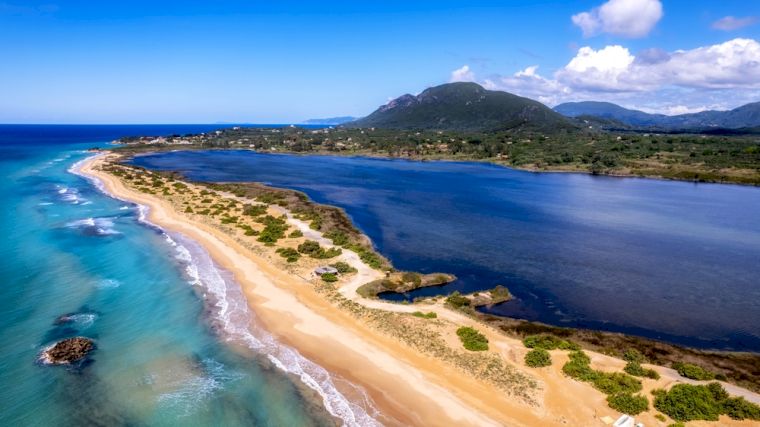
In stark contrast to the rugged coast of Palaiokastritsa is Lake Korission, a lagoon along the southwest coast of Corfu. It is a legacy of the Venetians, who built a canal to connect the marshland to the sea. The brackish wetland is a resting place for migratory birds. The best time to spot them is in the spring and fall. In the winter, it’s mainly various species of ducks that enjoy the mild weather.
From Chalikounas, you can drive along an unpaved path across the narrow spit of land between the lagoon and the sea to the Venetian canal. Drive carefully to avoid damaging the undercarriage of your rental car. Behind the dunes lies an incredibly long sandy beach that will never be developed for tourism, as this is a protected nature reserve. It can get quite crowded near Chalikounas in the summer, but the farther you go toward the canal, the quieter the beach becomes. A pedestrian bridge over the canal takes you to the other, more wooded part of the spit. Some trees and shrubs have been strangely twisted by the often strong westerly winds. Eventually, you’ll reach another beach, Issos, which is still very quiet here but gets crowded near the seaside resort of Agios Georgios.
Kassiopi
At first glance, the fishing village of Kassiopi seems to have been completely taken over by the tourism industry. The surrounding area is home to attractive beaches such as Kogevina, Avlaki, and Akoli. From the latter beach, you can see the Albanian coast, just three kilometers away. The beautiful, natural harbor of Kassiopi is teeming with taverns and cocktail bars, and the shops are also entirely geared toward tourists.
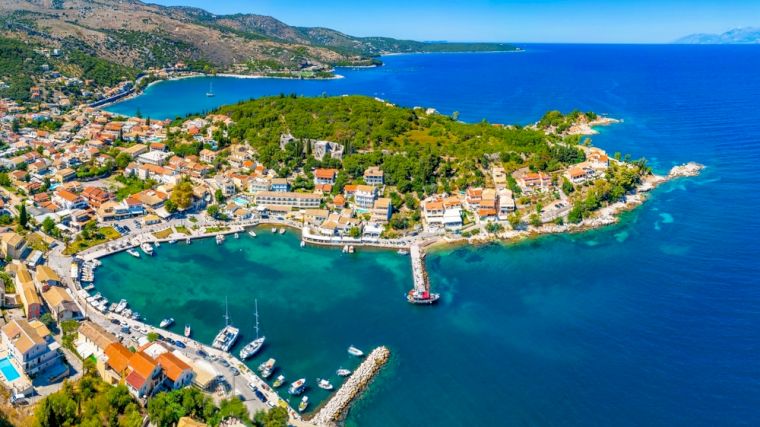
Still, Kassiopi has more to offer than just sun, sea, beach, and drinks. If you drive there in a rental car, you can park in a large lot just past the turnoff from the coastal road. From there, it’s less than four hundred meters on foot to the harbor. Just before the harbor, you’ll pass a small old church, Panagia Kassopitra. You walk to the entrance via a stone staircase and a leaf-covered arbor. Stone arches form a small courtyard with a wooden roof where swallows nest in the spring. There are niches for candles in the stone wall, with religious paintings above them. Here, you’re in a world completely different from the touristy Kassiopi, and you can feel the village’s history. This fascinating church was built in the fifth century on the ruins of a Greek temple dedicated to the supreme god Zeus and served as a pilgrimage site in the Middle Ages.
Across from the church, a path leads to the ruins of the Byzantine fortress that once stood there. It was built in the thirteenth century, later conquered by the Normans, and ultimately destroyed by the invading Venetians, who did not rebuild it. As a result, little remains of the fortress itself, but the view over Kassiopi and the sea is beautiful.
Palea Peritheia
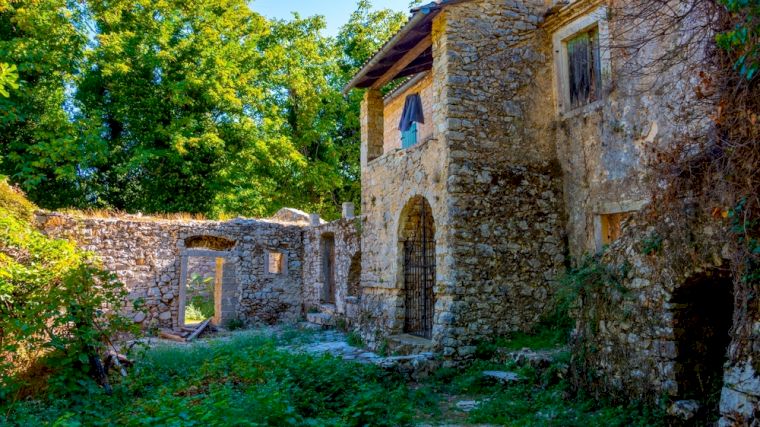
You can only reach the abandoned village of Peritheia from the north coast—that is, from Kassiopi or Acharavi. In both cases, first follow the coastal road (westward from Kassiopi, eastward from Acharavi). Then take the turnoff for Loutses and Peritheia, which is clearly marked on a sign. The road is fairly narrow and winding, but take it slow and you’ll be fine. Just watch out for oncoming traffic. As soon as you see a small church, the paved road ends and there’s space to park your rental car.
The village was originally founded in the fourteenth century, when people moved from the coast inland to protect themselves from pirate attacks. When piracy declined at the end of the nineteenth century, some residents moved back to the coast. But the coast’s greatest appeal didn’t emerge until the rise of tourism. It’s a strange experience to walk past the old, dilapidated houses of this ghost village, which once had no fewer than eight churches and chapels. Yet there’s still some life here, thanks to the taverns surrounding the small central square. The O Foros tavern generally receives the best reviews from visitors.
Take a rental car to the summit of Mount Pantokrator
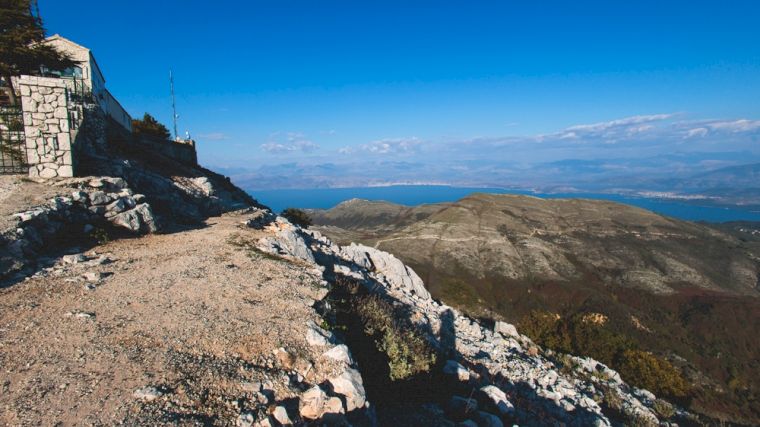
Do you enjoy a brisk hike? If so, you can hike from Oud-Peritheia to the summit of Mount Pantokrator, which, at 906 meters, is Corfu’s highest mountain. But if you’ve rented a car, it’s actually more fun to take that route by car. From Corfu, drive north along the coastal road, right past the southern slopes of Mount Pantokrator. Just past Agios Markos, there’s a turnoff (sharp curve) leading to the town of Spartílas. This narrow road winds past olive groves and terraces with stone walls. Along the way, you’ll enjoy beautiful views of the sea. After five kilometers of hairpin turns, you’ll reach the picturesque village of Spartílas, where the houses are surrounded by olive trees and flowers. Especially in the spring, the fragrant and colorful display of flowers is overwhelming. In the center, the main road narrows considerably. About one kilometer past Spartílas, turn right toward Petaleia. Note: you’ll first see a sign with only Greek text, but a little further on, the same directions are indicated in the Latin alphabet. The olive trees and cypresses give way to lower vegetation, including wild herbs. Ready for a break? You can stop in the village of Strinílas, where there’s a cozy terrace under the large tree in the village square. After that village, it’s still a good five kilometers’ drive to the summit of Pantokrator.
You can park your rental car along the side of the road, near the (ugly) cell towers. At the base of the largest tower stands a monastery with a beautiful silver iconostasis and stunning, detailed frescoes on the vaulted ceiling. As beautiful as it is, the monastery has to compete with the unparalleled view. You can see all of Corfu and, of course, Albania and the Greek mainland. On very clear days, you can even see the Italian coastline to the west, even though it’s 130 kilometers away.
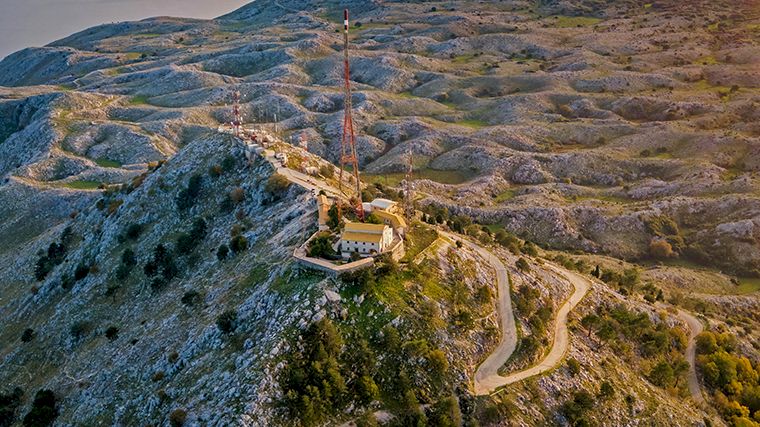
On the way back from the summit, don’t drive to Strinílas; instead, turn right toward Petália (follow the signs for Acharavi). After that village, the road first descends and then climbs to the Droseri lookout point, where you can park your rental car for a moment to enjoy the view of Corfu’s north coast. As you leave the village of Lafki, there’s another beautiful lookout point, but drive a little further to a side road where you can park safely, then walk back a short distance. In the next village, Agios Martinos, at a T-junction, you have the choice between heading toward Acharavi (to the left) or Kassiopi (to the right). Both are located on the main road along the coast.
Episkepsi / Nymfes Waterfall
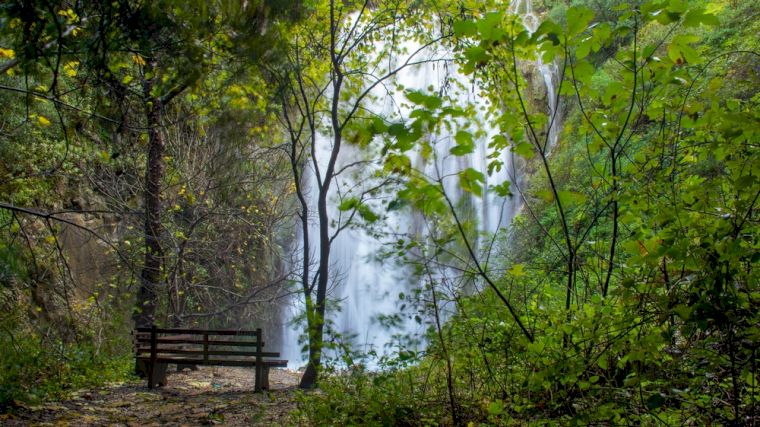
Still haven’t had enough of winding roads and charming little towns? Then drive from Acharavi to Episkepsi, about seven kilometers to the south. Bring a packed lunch, because just before the village there’s a lovely lookout point with a picnic table. Episkepsi is beautifully situated on a hill (with a view, of course) and is therefore considered one of Corfu’s most romantic villages.
Just outside the village, a trail leads to the Nymphs’ Waterfall, so named because, according to mythology, nymphs could bathe here, shielded from the prying eyes of outsiders by the lush vegetation. The trail is about one and a half kilometers long and follows steps—sometimes steep—made of earth and wood. Once you reach the bottom, you’ll see the water cascading fifteen meters down. Your best chance of seeing plenty of water is in the spring. It’s certainly not quiet there, as birds and frogs make themselves heard loud and clear. Dragonflies buzz through the dense vegetation. It’s a magical place, especially since few people make this hike and, with a little luck, you’ll be all alone.
You can also reach the waterfall from the village of the same name, Nymfes. A dirt road leads past the local soccer field to the waterfall.
Lefkimmi / Paxos
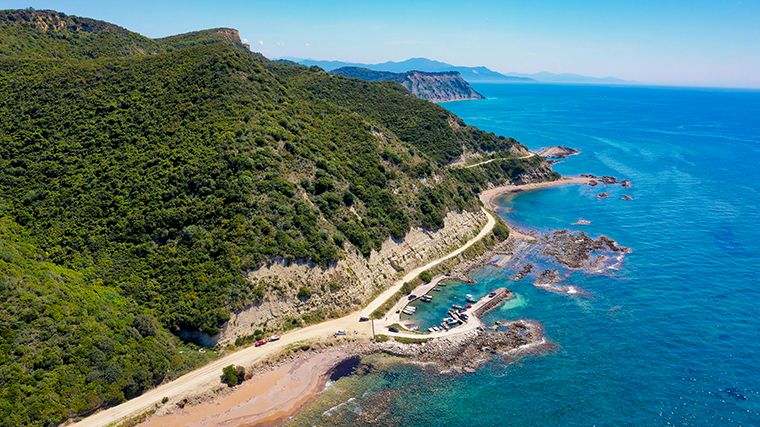
Lefkimmi is the “capital” of southern Corfu. Well, “city”… it’s home to only about five thousand people. From Corfu Town, it’s a drive of just over forty kilometers along the coastal road to Lefkimmi—a bit longer if you take the mountain road for the first part of the journey. Although tourism plays a major role in this town as well, much has remained the same. A small canal runs right through Lefkimmi. That in itself isn’t particularly remarkable, but along the water you can relax at one of the many outdoor cafes. The nearby town of Kavos attracts many young people, but you hardly notice that in Lefkimmi. The town has a wide sandy beach, Bouka, that slopes very gently into the water. This makes it a wonderful destination for a day at the beach with small children. Outside of August, this is a fairly quiet beach.
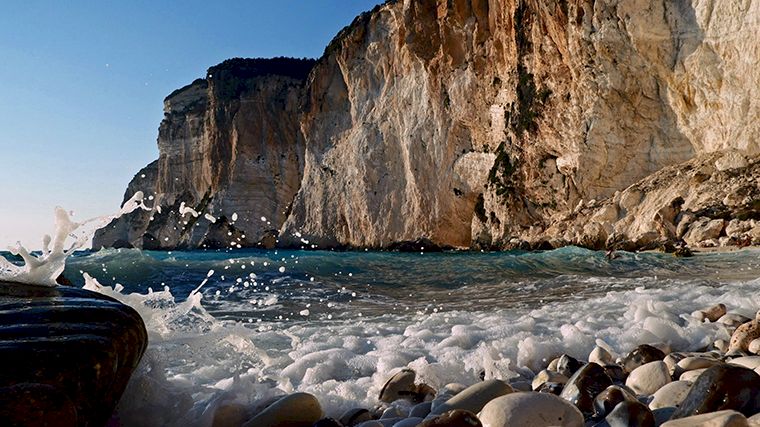
Ferries depart from Lefkimmi to Igoumenitsa on the Greek mainland and to the beautiful islands of Paxos and Antipaxos. There are also day trips by boat to these islands, just south of Corfu. Many of the coves, sea caves, and secluded beaches are only accessible by boat, such as the iconic caves of Tripitos. The smaller island of Antipaxos is famous for its pristine beaches and crystal-clear waters.
Pelekas / Kaiser’s Throne
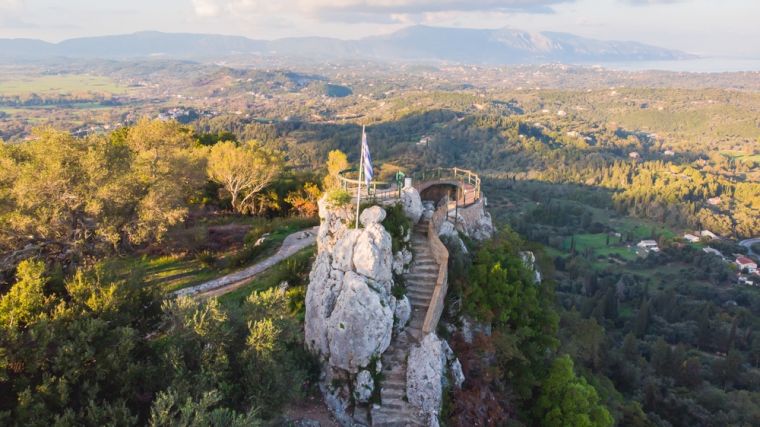
A few years before World War I, German Emperor Wilhelm II spent his summers at the Achilleion Palace, and his favorite outing was to the village of Pelekas to watch the sunset. There is a rock there that he turned into his personal vantage point, which is why it is known to this day as the Kaiser’s Throne. When you stand at the top of the lookout point, you’ll see why Corfu is called the greenest island in Greece. It can get quite crowded here around sunset, and space is limited at the highest point. Don’t worry, though—you can also enjoy the view from the terrace of the adjacent Levant Hotel.
Porto Timoni Beach
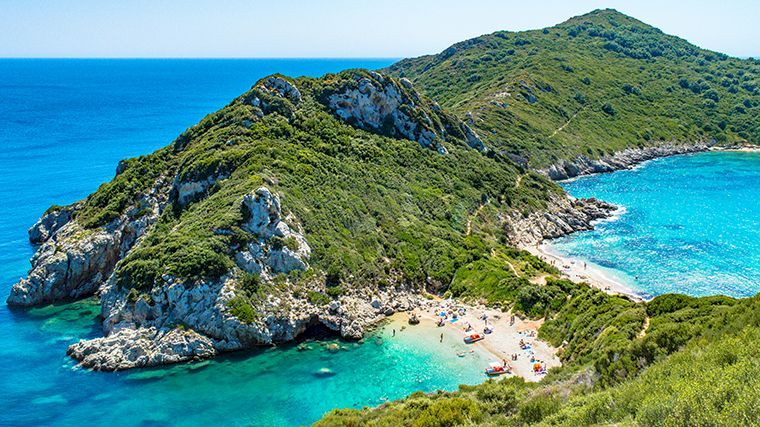
There are many beautiful beaches on Corfu, but one of the most beautiful is definitely Porto Timoni. Or rather, two of the most beautiful, since it’s a twin beach on either side of an isthmus. Porto Timoni is located near the popular, long sandy beach of Agios Georgios Armenadon on Corfu’s west coast, but it’s a bit harder to reach. You have to walk a short distance to get there, and the descent (and the climb back up) aren’t for everyone. But as is often the case after a bit of effort: the reward is well worth it.
Park your rental car in a designated lot at the entrance to the village of Afionas. From the parking lot, it’s a 1.5-kilometer walk to the beaches, first along a paved road and then along a trail that becomes quite steep toward the end. Don’t walk this path in flip-flops; be sure to wear (athletic) shoes. Along the way, you’ll enjoy fantastic views of the beaches. Don’t feel like doing this bit of scrambling? In Agios Georgios, you can also take a taxi boat to the beach or sail there yourself in a rented boat. You’ll miss out on the charming village of Afionas and the spectacular view of the twin beaches, though.
Aqualand
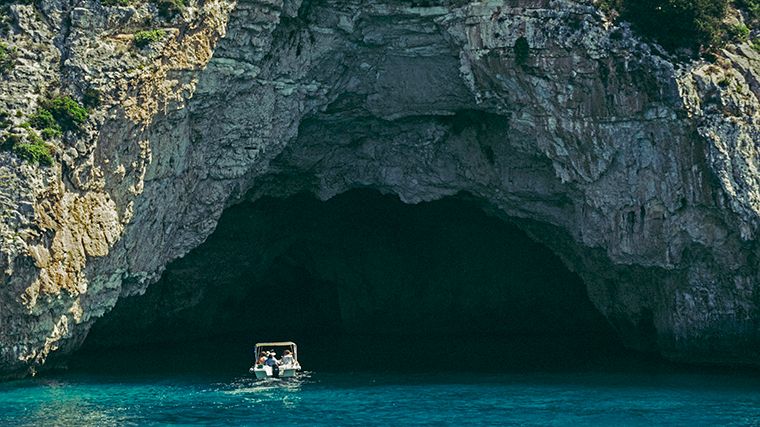
Are the kids tired of sitting in the car or hanging out on the beach, and are they in the mood for some action? But with water, of course, because it’s often pretty hot in Corfu. Take them to Aqualand, just a 15-minute drive from the center of the capital or a little over an hour from the north coast. Fun guaranteed! The water park is open from early May to early October and is considered one of the best in Europe. And it’s not just for kids—there are some really challenging slides and other water attractions that adults will enjoy too. If you want to take a break, you can float peacefully along the “lazy river.”
Why rent a car in Corfu?
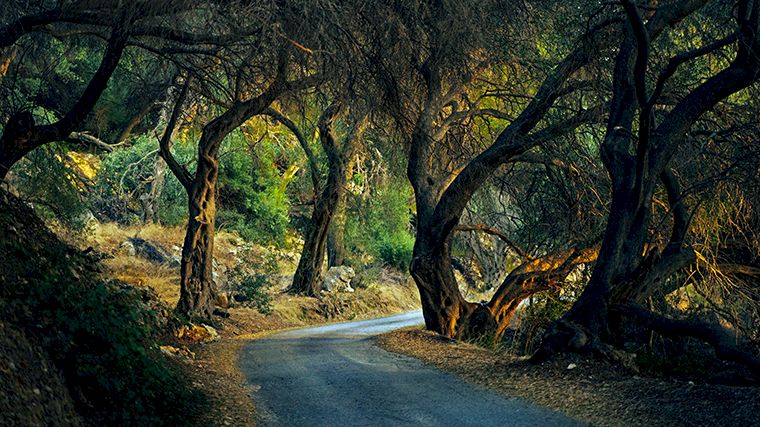
We hope the tips above have inspired you to take a vacation in Corfu. If you don’t want to stay in just one place, your best bet is to rent a car. While there is public transportation on the island, do you really want to waste time waiting for the bus every time? Plus, the buses don’t go everywhere. And taking a taxi every time you want to go somewhere can get pretty expensive. Plus, a rental car gives you much more flexibility. Found a nice spot? Just pull over. Or, if a place isn’t as nice as you thought it would be, hop in your rental car and drive somewhere else. Changed your plans? No problem at all when you have your own transportation. So rent a car to drive from bay to bay and from village to village. That way, you’ll really get the most out of your vacation in Corfu!
Driving a Rental Car in Corfu
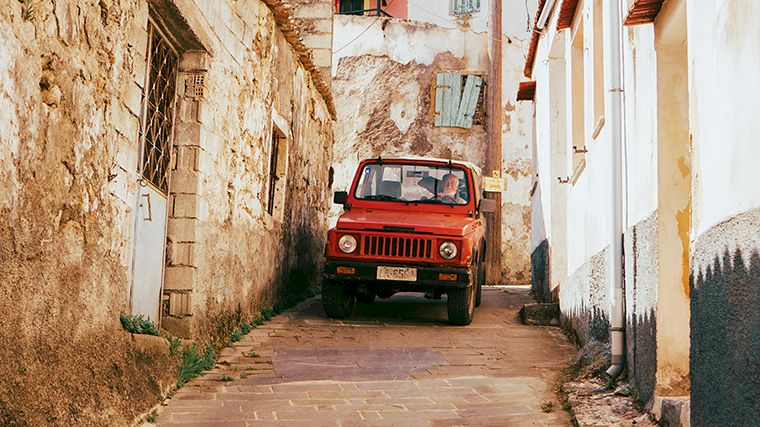
The main roads on Corfu are generally in good condition, but the quality of secondary roads varies considerably. Always be aware of changing conditions. While the first part of a road may be in good condition, conditions further along may be different. You may also occasionally find that a paved road turns into a gravel road. Drive slowly and carefully on these sections to prevent damage to the undercarriage of your rental car. Incidentally, most rental cars with our Worry-Free label come with comprehensive coverage, which covers such damage under the insurance policy. Furthermore, the streets in towns and villages are often very narrow. The best option is usually to park on the outskirts of a village and continue on foot.
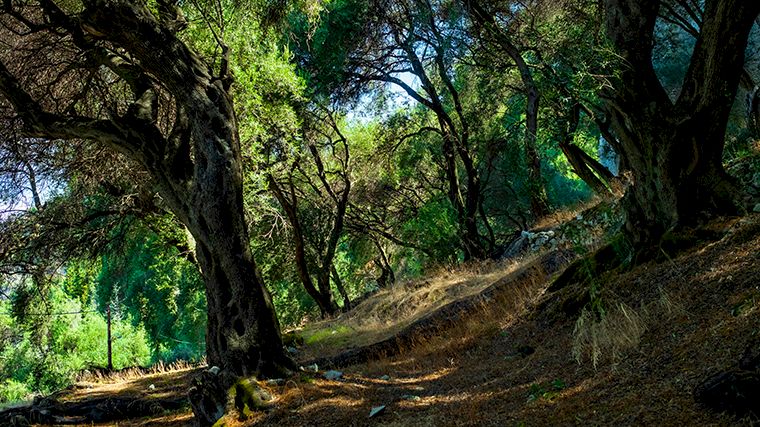
Main roads on Corfu are officially numbered, but this is rarely indicated on the signs. So make sure to memorize your destination and the (larger) villages you’ll pass along the way, or write them down on a piece of paper. That way, you can easily find your route, since fortunately most place names are listed in both the Greek and Latin alphabets on the road signs. Roads in mountainous areas are, of course, winding. Always be mindful of oncoming traffic and drive with foresight. The southern part of the island is flatter than the north, but even there you’ll occasionally have to navigate roads with hairpin turns. A small rental car is great for the narrow streets of Corfu, but be sure to rent a car with enough engine power to drive comfortably in the mountains.

Where would you like to rent a car?
- 24000+ pick-up locations
- Free cancellation
- Independent comparator

Useful tips for a well-prepared trip
Which insurance should I choose, and what's the deal with the deposit? Read our articles with useful information and tips to ensure you choose the right rental car for you.


